







Standard TFT Display Sizes: 2026 Size Chart & Selection Guide
Common TFT display sizes, resolutions and interfaces, plus how to choose the right size for industrial, medical and consumer products.
 ByBill Hu


Common TFT display sizes, resolutions and interfaces, plus how to choose the right size for industrial, medical and consumer products.
ByBill Hu
Compare TFT LCD interfaces: MCU, SPI, RGB, MIPI DSI, LVDS and eDP, with bandwidth, cable length and selection guidance for embedded designs.
ByBill Hu
A 12-inch TFT LCD display module is a widely used display module. 12 inches corresponds to a 304.8mm diameter. It is widely used in industrial automation, automotive display systems, medical equipment, security monitoring, consumer electronics, and commercial equipment. Below, we…
ByBill Hu
A 1.8-inch TFT LCD display module is a small-size, low-power display module. Its dimensions are 34mm44mm, with a pixel count of 128160px. It uses an SPI interface and an ST7735S driver IC. Its operating temperature range is -20℃ to +70℃.…
ByBill Hu
When shopping for a new monitor, smartphone, or TV, you’ve likely encountered acronyms like LCD, TFT, IPS, LED, and OLED. But what exactly do these terms mean? Are they competing technologies, or do they overlap? In this comprehensive guide, we’ll…
ByBill Hu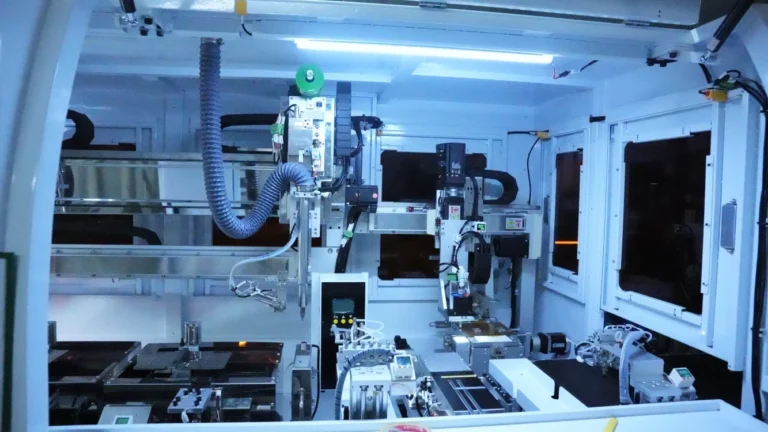
Quick Answer: TFT LCD and OLED are fundamentally different display technologies. TFT LCD uses a backlight shining through liquid crystals and color filters, offering 50,000–70,000 hour lifespan, no burn-in risk, and lower cost—making it ideal for industrial, medical, and automotive…
ByBill Hu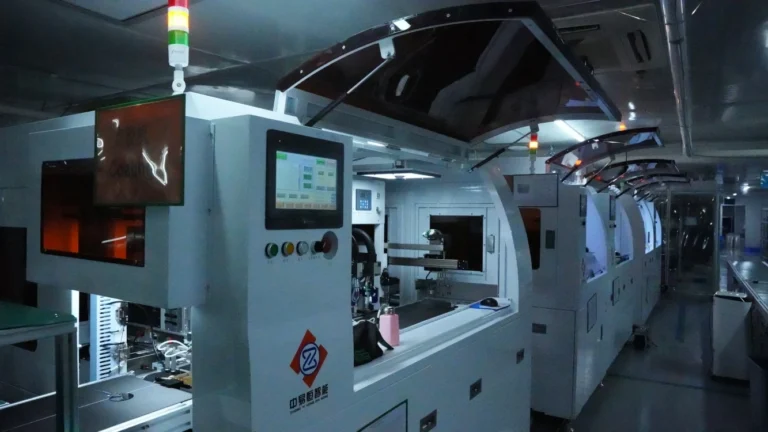
Quick Answer: LCD black spots are dark, non-illuminated areas on a screen caused by three distinct mechanisms: dead pixels (failed TFT transistors), external dirt or debris (surface contamination), or pressure damage (liquid crystal layer disruption). Dead pixels are permanent hardware…
ByBill Hu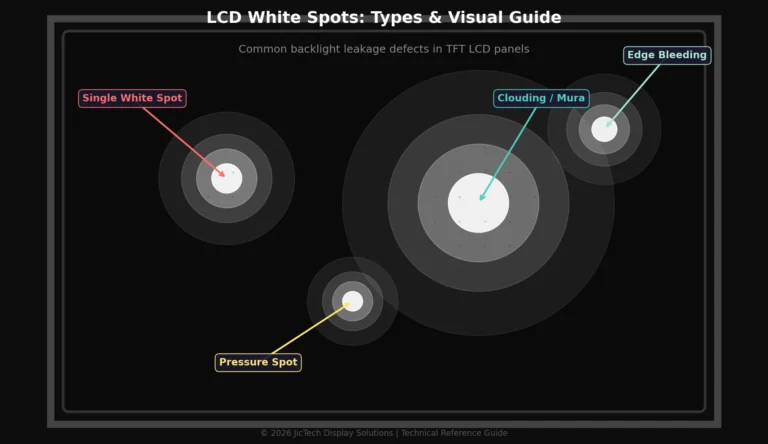
Quick Answer: LCD white spots are bright, irregular patches that appear when the backlight leaks through gaps in the liquid crystal layer, diffuser plate, or polarizer film. They are commonly caused by physical pressure, thermal stress, manufacturing defects, or aging…
ByBill Hu