








Technical Analysis Quality
From a purely technical perspective, the quality of TFT-LCD is reliable, durable, and well-balanced. Its core mechanism – using thin-film transistors to independently control each pixel, combined with quantifiable performance metrics – forms a solid foundation for its capabilities as a display technology.
We can break down its quality through several key hardware dimensions. The table below provides an intuitive overview of these technical specifications:
| Technical Dimension | Core Indicators / Parameters | Impact on “Quality” |
|---|---|---|
| Core Driving | Active matrix, one TFT per pixel | The foundation of all performance – enables high speed, brightness, and contrast |
| Resolution | From SD (e.g., QVGA) to UHD (e.g., 4K 3840×2160) | Determines image fineness and detail rendering |
| Color Reproduction | Color gamut (e.g., 45% NTSC), color depth (e.g., 16.7M colors) | Determines color accuracy, vividness, and gradation |
| Refresh Rate | Standard 60Hz, high refresh up to 144Hz or even 610Hz | Affects motion smoothness; reduces tearing and blur |
| Response Time | Modern TFT panels: 1ms to several tens of ms | Determines pixel switching speed, critical for clarity of fast-moving images, eliminates trailing |
| Contrast Ratio | Typically >1000:1; premium >3000:1 | Affects image depth and dimensionality; high contrast gives deeper blacks and brighter highlights |
| Brightness | Typical 250–350 nits; outdoor >3500 nits | Determines visibility in bright environments; crucial for outdoor/specialized applications |
| Viewing Angle | Narrow for TN; IPS/VA can exceed 80° in all directions | Determines color/contrast shift when viewed from sides; wide angle is essential for premium applications |
| Backlight Technology | Early: CCFL; modern mainstream: LED | LED brings higher brightness, lower power consumption, thinner modules |
| Reliability / Lifespan | Typically >50,000 hours | Determines product durability and long-term operational stability |
In modern usage, “TFT” refers primarily to the driving technology of the LCD panel, not a specific screen type. Common panel types like TN, IPS, VA are all specific implementations based on TFT driving technology.
Deep Dive: How Key Performance Parameters Shape Quality
Color Rendering
The color quality of a TFT-LCD is determined by two key parameters: color gamut and color depth.
- Color Gamut defines the range of colors the display can produce.
- Many mainstream consumer TFT screens have a color gamut of around 45% NTSC.
- Through material and design optimization, premium TFT panels can reach 110% NTSC, covering wider color standards (like sRGB, DCI-P3) and delivering richer, more vibrant colors. These are used in professional design and high-end consumer electronics.
- Color Depth determines the smoothness of color transitions.
- Early TFT screens were often 6-bit (about 262,000 colors), leading to less smooth gradients.
- Mainstream and premium panels commonly use 8-bit (about 16.7 million colors), achieving very smooth and natural color gradation.
Motion Performance
Two key metrics define motion performance: refresh rate and response time.
- Refresh Rate: Standard screens run at 60Hz, sufficient for office work and video playback. High-refresh-rate gaming screens reach 144Hz, 360Hz, and as shown by Tianma in 2026, up to 610Hz. High refresh rates make gaming and fast-scrolling content extremely smooth, significantly reducing motion blur.
- Response Time: Early TFT screens had response times around 30ms, causing noticeable trailing in fast motion. Modern gaming monitors achieve 1ms GTG (gray-to-gray) response time, virtually eliminating trailing – critical for fast-paced games like FPS.
Visuals & Durability
- Viewing Angle: A key differentiator among panel types and an area where TFT technology has continuously evolved.
- TN (Twisted Nematic): The oldest technology, very narrow viewing angles (typically ~130° horizontal); severe color shift or even negative effect from the side.
- VA (Vertical Alignment): Better than TN (~170°), highest contrast ratio.
- IPS (In-Plane Switching): Best viewing angles, up to ~178° in all directions, minimal color shift.
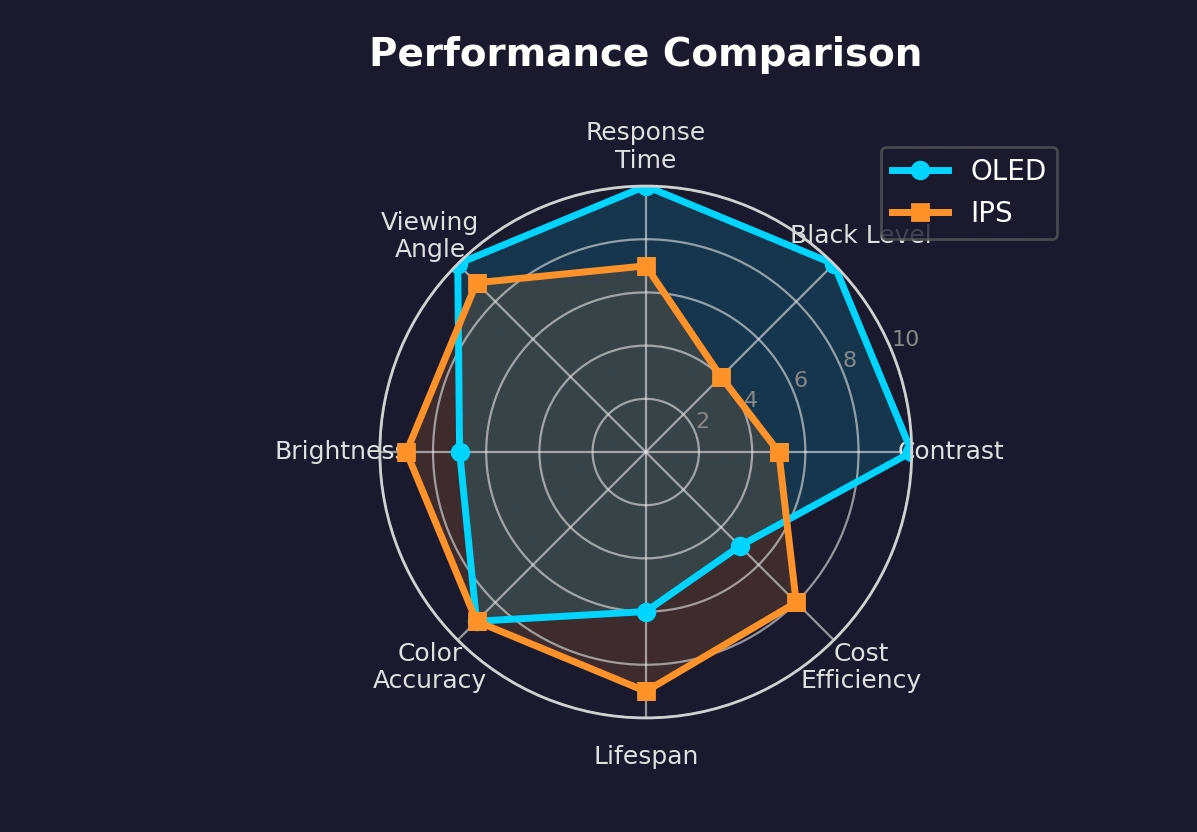
- Operating Life: A major technical advantage of TFT-LCD is its excellent lifespan and stability. Typical commercial TFT panels are designed for >50,000 hours. At 8 hours of daily use, that’s over 17 years. The LED backlight also avoids the “burn-in” risk (permanent image retention) that plagues OLED screens, making TFT-LCD very reliable.
Reliability Challenges
Though very reliable, TFT-LCD still needs special design for extreme environments. Performance is affected by temperature:
- High temperatures accelerate aging of liquid crystal material and electronic components, leading to display anomalies.
- Low temperatures slow down liquid crystal molecules, increasing response time and causing trailing or ghosting.
Therefore, TFT screens for outdoor or industrial use often employ ultra-wide temperature range designs to ensure stable operation under harsh conditions.
Summary
Overall, the quality of TFT-LCD is excellent and reliable.
- Strengths: It remains highly competitive in long lifespan, high brightness, excellent cost-performance, and no burn-in risk. Ideal for daily office work, home TVs, industrial equipment, and other applications demanding stability and reliability.
- Weaknesses (compared to newer technologies like OLED): Falls short in ultimate contrast ratio, panel thinness, and power efficiency. For users seeking ultimate picture quality and ultra-thin designs, OLED or other emerging technologies may be more attractive.
Thus, TFT-LCD is a “high-quality, cost-effective technology choice.” Whether its quality is “good enough” depends entirely on whether it matches your application scenario and budget.