








Introduction
You’re standing at a bus stop on a bright summer afternoon. The digital display that’s supposed to tell you when the next bus arrives is completely washed out—you can barely make out the numbers. Or you’re at the airport, watching passengers fumble with flimsy paper luggage tags that peel off before the bags even reach the plane. Or you’re driving through a city, circling blocks because the parking signs give no indication of which spots are actually available.
These aren’t isolated problems. They’re the result of using the wrong display technology for the environment.
Here’s what’s changing, and why e-paper is becoming the default choice for transportation infrastructure.
Why Transportation Displays Are Different
Transportation displays face a set of conditions that most other displays don’t.
They sit outdoors, exposed to sun, rain, dust, and temperature swings from freezing winters to scorching summers. They often have no access to mains power—many bus stops and parking signs were never designed with electrical wiring in mind. They need to show information that changes in real time, but they also need to be readable in conditions where traditional screens fail. And they need to do all of this with minimal maintenance, because transportation agencies don’t have the budgets for constant repairs.
E-paper addresses all of these constraints in ways that LCDs and LEDs simply can’t.
Bus Stops: Real-Time Information, Real-World Conditions
The Problem with What Came Before
For decades, bus stops have relied on two things: paper timetables and LED dot-matrix displays.
Paper timetables are static. When a route changes or a bus runs late, the information is wrong. And with 25,000 printed bus timetables in a single transit network, keeping them accurate is a losing battle.
LED displays are better—they can show real-time information. But they come with their own problems. They consume a lot of power. They need to be wired to the grid, which means digging up streets and running cables. They’re difficult to read in direct sunlight. And they’re expensive to install and maintain.
How E-Paper Changes the Equation
E-paper flips the logic entirely.
Because e-paper is reflective, it uses ambient light to show images. In direct sunlight, e-paper gets clearer—the opposite of what happens with LED or LCD screens. There’s no glare, no washout, no squinting.
Because e-paper is bistable, it only consumes power when the content changes. A static image—like a bus timetable—requires zero power to maintain. This means e-paper displays can run on solar power or long-life batteries.
The energy savings are dramatic. A typical LED bus stop display consumes about 1,080 Wh per day. A Papercast e-paper display uses just 15 Wh per day—a 98.6% reduction. Another analysis found that Papercast’s 28-inch e-paper display is 141 times more energy-efficient than a 3-line LED display.
This isn’t a marginal improvement. It’s the difference between a display that needs to be wired to the grid and one that can run on a solar panel the size of a piece of paper.
What’s Actually Being Deployed
The technology is scaling fast.
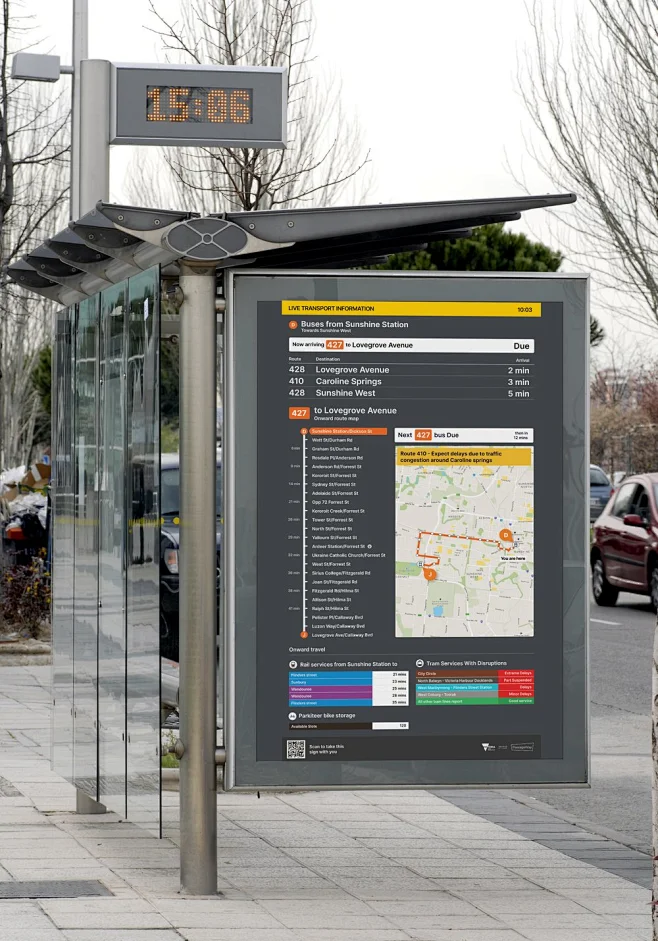
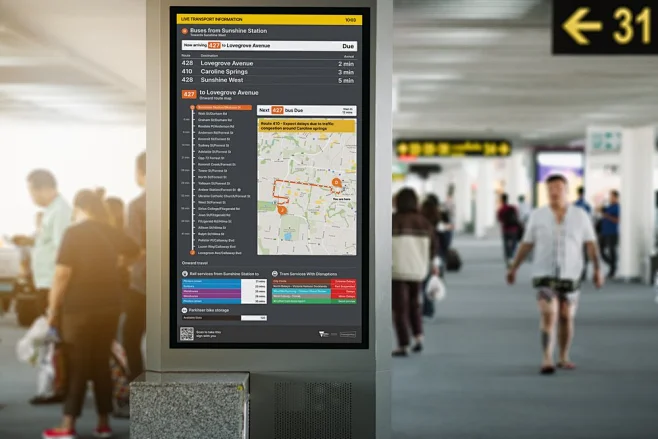
Papercast has become a major player in this space. Their 28-inch e-paper display is emerging as a new standard for bus stop countdown displays. It’s designed to fit directly into existing bus stop housings—a direct replacement for older LED units that doesn’t require major infrastructure changes.
In a recent trial conducted by one of the world’s largest city transport authorities, passengers preferred the e-paper display over LED by 22% among those aged 16–54. They perceived it as more reliable—62% vs 48% for LED—even though both displays showed the same live data. One accessibility stakeholder noted that the e-paper display “does not suffer from light issues like other digital boards when the sun is out”. Passengers with visual impairments cited the contrast, font clarity, and reduced glare as making it significantly easier to read.
Perhaps most telling: infrequent bus users reported a 26% increase in confidence to travel when using a stop with the e-paper display.
Connectpoint has taken a similar approach, focusing on solar-powered e-paper displays that require no wired electrical connection. In Portland, Oregon, transit agency TriMet has installed over 450 solar-powered e-paper displays across its network—111 of them since the beginning of 2024. They’ve since signed a second five-year contract to continue expanding the deployment. The displays come in 13-inch and 32-inch sizes and are managed through a cloud-based content system that allows remote updates and performance monitoring.
The agency’s senior project manager put it simply: “We’re no longer limited by where we can dig or connect to the grid. With solar-powered displays, we can deliver real-time information anywhere”.
Australia’s Queensland has taken a statewide approach. The Department of Transport and Main Roads has completed the deployment of nearly 300 solar-powered e-paper bus stop displays across the state. The displays show real-time departure information and disruption notifications, and include accessibility features like audible timetable buttons that read aloud the next buses to arrive.
China’s Yangzhou city has taken a more localized but equally telling approach. Thirty-nine bus stops have been upgraded with e-paper displays powered by rooftop solar panels. Each display consumes just 17 kWh per year. Compare that to a 32-inch outdoor LCD screen, which would consume 596.2 kWh more annually—equivalent to saving 238.5 kg of standard coal and reducing CO2 emissions by 594.4 kg per display. The displays are self-sufficient, requiring no external power connection.
SEEKINK offers three e-paper display sizes for transit applications—13.3-inch, 28-inch, and 31.2-inch. Their 28-inch solution operates from -15°C to +65°C, features IP65 and IK08 protection, and can update content in under two seconds. It’s a complete system with integrated control and front light—readable in extreme sunlight or darkness.
Toronto is deploying e-paper passenger information displays across buses and transit stops as part of a broader modernization effort ahead of the FIFA World Cup 2026. The onboard e-paper screens provide next-stop information, terminal connections, and subway service alerts.
Riga, Latvia has also made the switch. The city’s public transportation operator replaced LED displays with Papercast e-paper units, achieving significant cost and carbon savings.
Sweden’s REVG signed a framework agreement for a minimum of 540 solar-powered e-paper displays, with an option to expand to 1,500 units.
The Bigger Picture
What’s driving all of this isn’t just the technology—it’s the business case. E-paper displays eliminate the need for trenching, cabling, and grid power. They can be installed in under an hour. They reduce both installation and running costs. And they keep working even during power outages.
For transit agencies operating on tight budgets, that’s a compelling combination.
Electronic Luggage Tags: The End of Paper Labels
The Paper Problem
Every year, billions of paper luggage tags are printed, attached to bags, and then discarded after a single flight. They tear. They fall off. They get smudged and unreadable. And if your flight changes, the information on the tag is wrong.
The E-Paper Solution
Electronic luggage tags replace all of that with a single reusable device.
The BAGTAG Flex is the only batteryless electronic bag tag on the market. It uses an e-paper display and is powered entirely by the NFC signal from a smartphone during check-in. No battery to charge. No battery to replace. It lasts for a lifetime of travel.
Here’s how it works: you check in via the airline’s app, hold your phone against the tag, and the NFC signal transfers both power and data to the e-paper display. The tag updates with your flight information, baggage barcode, and destination. Once updated, the e-paper display holds the image permanently—no power required. You drop your bag at the airport and go.
The impact is measurable. BAGTAG users have saved 300 kilometers of paper every time 350,000 users use the tag instead of a traditional paper luggage label. The device eliminates the need for non-recyclable labels and reduces both ink and energy consumption at the airport.
Alaska Airlines has also launched an electronic bag tag program, using NFC-powered tags that don’t require charging or batteries. The tags can be used on Alaska Airlines flights, including those operated by Horizon and SkyWest.
Why It Works
The key insight is that an e-paper display only needs to update once per flight—when you check your bag. Between flights, it sits there, showing the same information, consuming zero power. The display is durable enough to survive baggage handling, and because it has no battery, there’s nothing to fail.
For airlines, the math is simple: fewer paper tags to print, less waste, faster check-in, and happier passengers. For passengers, it means skipping the check-in line and going straight to baggage drop.
Parking Signs: Dynamic Management Without the Wiring
The Static Problem
Most parking signs are still static pieces of metal. They tell you the rules, but they don’t tell you if there’s actually a space available. Drivers circle blocks looking for spots, adding to congestion and emissions.
The E-Paper Solution
Dynamic parking signage changes this. E-paper displays can show real-time availability, pricing changes, and wayfinding information—all without needing to be wired to the grid.
The technology is already being deployed. Sydney has deployed smart parking signs using E Ink Kaleido 3 Outdoor color e-paper technology, allowing city officials to dynamically adjust parking signs based on traffic conditions.
Papercast offers solar-powered parking displays that can guide vehicles to available spaces. These displays are readable in direct sunlight, run on solar power, and can be updated remotely.
Q’PIN’s ‘Design’k’ takes a different approach—a smart parking number plate that uses four-color e-paper and solar panels, allowing it to be used in vehicles without worrying about power consumption. Users can change the displayed information at any time, protecting personal information while making it easy for others to reach them if needed.
The Advantage
Like bus stop displays, parking signs benefit from e-paper’s low power consumption and sunlight readability. They can be placed anywhere—on street poles, in parking garages, on curbs—without running power cables. They update remotely, so a city can change parking rates or restrictions across an entire neighborhood with a single command.
And because e-paper is reflective, it doesn’t contribute to light pollution—a growing concern in dense urban areas.
Why E-Paper Keeps Winning in Transportation
There’s a reason e-paper is displacing LEDs and LCDs in transportation applications. It’s not just one thing—it’s the combination.
Sunlight readability. E-paper is reflective, so it’s most readable in bright conditions. This is where other displays fail.
Ultra-low power. A static e-paper display consumes essentially zero power. This enables solar-powered, off-grid deployment at scale.
Bistability. If the power goes out, the display keeps showing information. No blank screens. No confusion.
Durability. Industrial e-paper modules operate from -15°C to +65°C with IP65 and IK08 protection. They survive rain, dust, and temperature swings.
No light pollution. E-paper doesn’t emit light, so it doesn’t contribute to nighttime light pollution. It’s earned DarkSky certification—the first display technology to do so.
Low maintenance. Fewer moving parts, no backlights to replace, no batteries to change (in many cases). For transportation agencies, this means lower total cost of ownership.
Remote management. Content can be updated from a central system—whether it’s a bus arrival time, a parking rate, or an emergency alert.
Choosing the Right Module for Transportation Applications
If you’re sourcing e-paper modules for a transportation application, here’s what to consider:
Size. Bus stop signs typically need 13-inch, 28-inch, or 31.2-inch displays. Luggage tags are much smaller—3 to 4 inches. Parking signs fall somewhere in between.
Color. Black and white works for most transit information. Color e-paper is increasingly available for applications like parking signs that need to distinguish different zones or restrictions.
Protection. Outdoor applications need IP65 or better. Look for IK08 impact resistance for bus stop installations.
Temperature range. Confirm that the module matches your local climate. SEEKINK’s 28-inch display, for example, operates from -15°C to +65°C.
Power source. Solar plus battery is the winning combination for most outdoor transportation applications.
Connectivity. Does the module support remote updates? How quickly can content be pushed to the display? SEEKINK’s solution updates in ≤2 seconds.
At Jictech, we design and manufacture custom e-paper display modules for transportation and outdoor applications. From bus stop signage to luggage tags to parking displays, we can tailor a module to your specific requirements. Visit https://jiclcd.com/e-paper/ to explore our e-paper product line, or check out https://jiclcd.com/industrial-display/ for our broader industrial display solutions.
The Bottom Line
Transportation infrastructure is being asked to do more with less. More real-time information. Less energy. More accessibility. Less maintenance. More deployment flexibility. Less cost.
E-paper isn’t the only display technology that can do some of these things. But it’s the only one that can do all of them—in direct sunlight, off the grid, with near-zero power consumption, and with the durability to survive outdoor conditions for years.
That’s why transit agencies from Portland to Queensland to Toronto are deploying it at scale. That’s why airlines are adopting it for baggage. And that’s why parking authorities are putting it on curbs and poles.
Transportation is moving away from LEDs and paper. E-paper is moving in.
FAQs
Yes. E-paper is reflective—it uses ambient light to show images. In direct sunlight, e-paper becomes clearer, not harder to read.
E-paper is bistable. Once an image is set, it stays in place without any power. The display only consumes energy when the content changes.
Yes. Many transportation e-paper displays are solar-powered, including those from Papercast, Connectpoint, SEEKINK, and others. A single solar panel can keep them running indefinitely.
Industrial e-paper modules typically operate from -15°C to +65°C, with some products supporting even wider ranges.
Many electronic baggage tags are batteryless—they’re powered by the NFC signal from a smartphone during check-in. The e-paper display holds the image permanently after the update.
Yes. E-paper parking signs can be updated from a central management system, enabling dynamic pricing, real-time availability, and remote content changes.
Yes. Outdoor e-paper modules feature IP65 dust and water protection and IK08 impact resistance. They’re designed to survive rain, dust, temperature swings, and physical impact.