








Overview
Choosing between OLED and IPS displays is one of the most common dilemmas in the display industry today. Whether you are sourcing panels for a new product line, upgrading your monitor, or simply curious about display technology, understanding the real differences matters. Both technologies have matured significantly, and each has carved out its own territory in the market. This article breaks down the comparison into practical terms—what actually matters when you are making a decision.
OLED vs IPS: Feature Comparison
Before diving into the technical weeds, here is a side-by-side look at the core characteristics that define each technology.
| Feature | OLED (Organic Light-Emitting Diode) | IPS (In-Plane Switching) |
|---|---|---|
| Light Source | Self-emissive organic compounds | Backlight (LED) with liquid crystal layer |
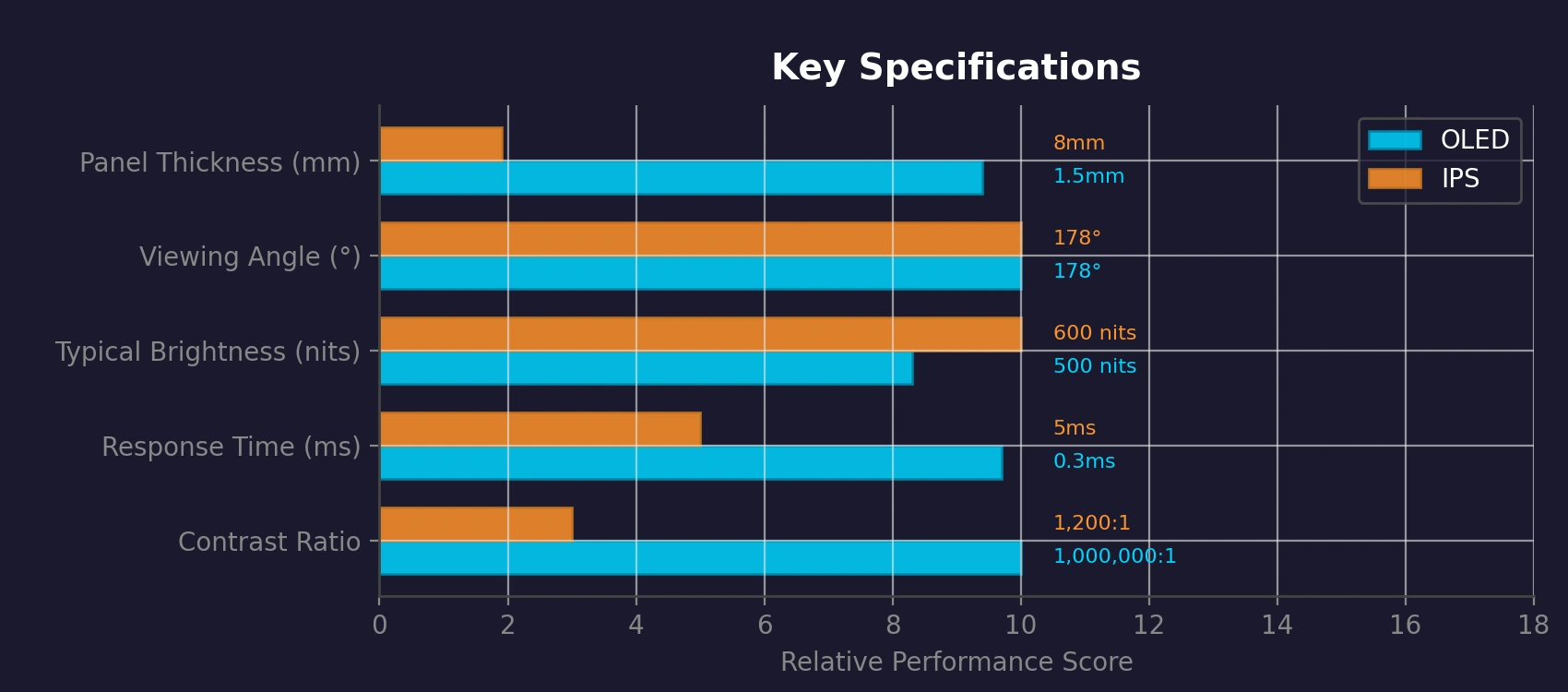
| Panel Thickness | Ultra-thin, often under 2mm | Thicker, typically 5–10mm |
| Power Consumption | Lower for dark content; higher for bright white screens | Relatively consistent regardless of content |
| Flexibility | Can be made flexible or foldable | Rigid only |
| Lifespan Concerns | Organic materials degrade over time; blue subpixels age faster | Longer stable lifespan; minimal degradation |
| Manufacturing Cost | Higher per unit, especially for large sizes | Lower and more scalable |
| Typical Sizes | Strong in small-to-medium sizes; growing in TV sizes | Dominates monitors, laptops, and large-format displays |
| Burn-in Risk | Present, especially with static images | Virtually none |
| Best Use Case | High contrast, portable, premium devices | Color-critical work, long-term static content |
How They Work: Technology Principles and Trade-offs
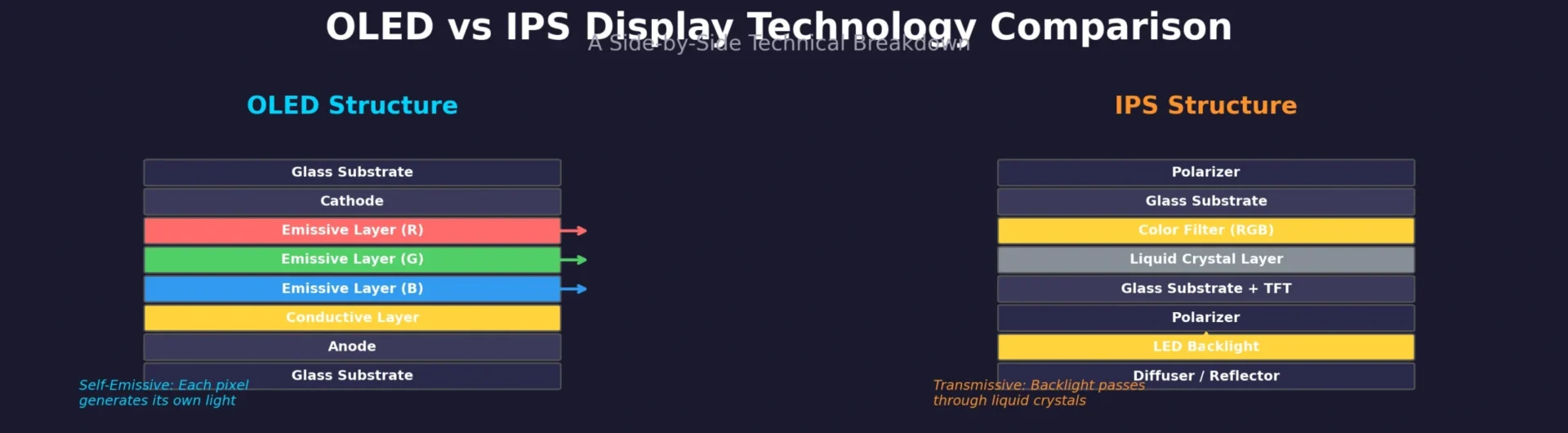
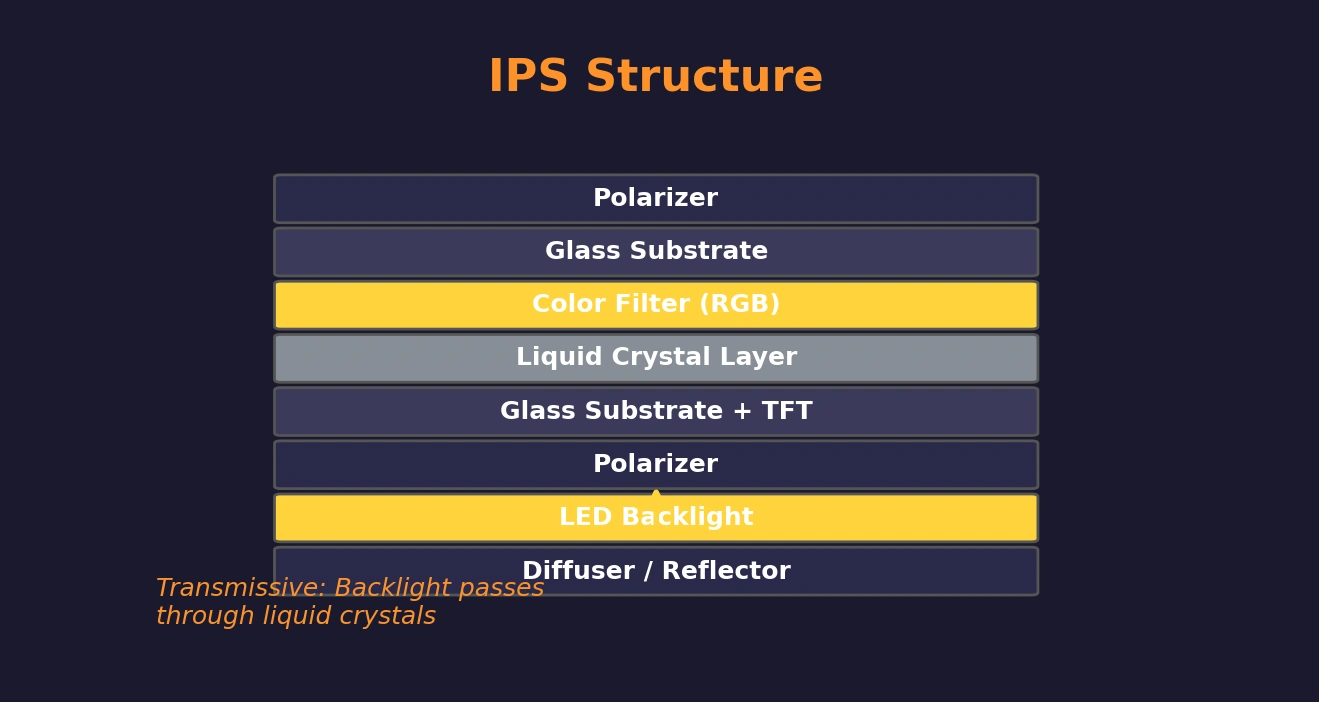
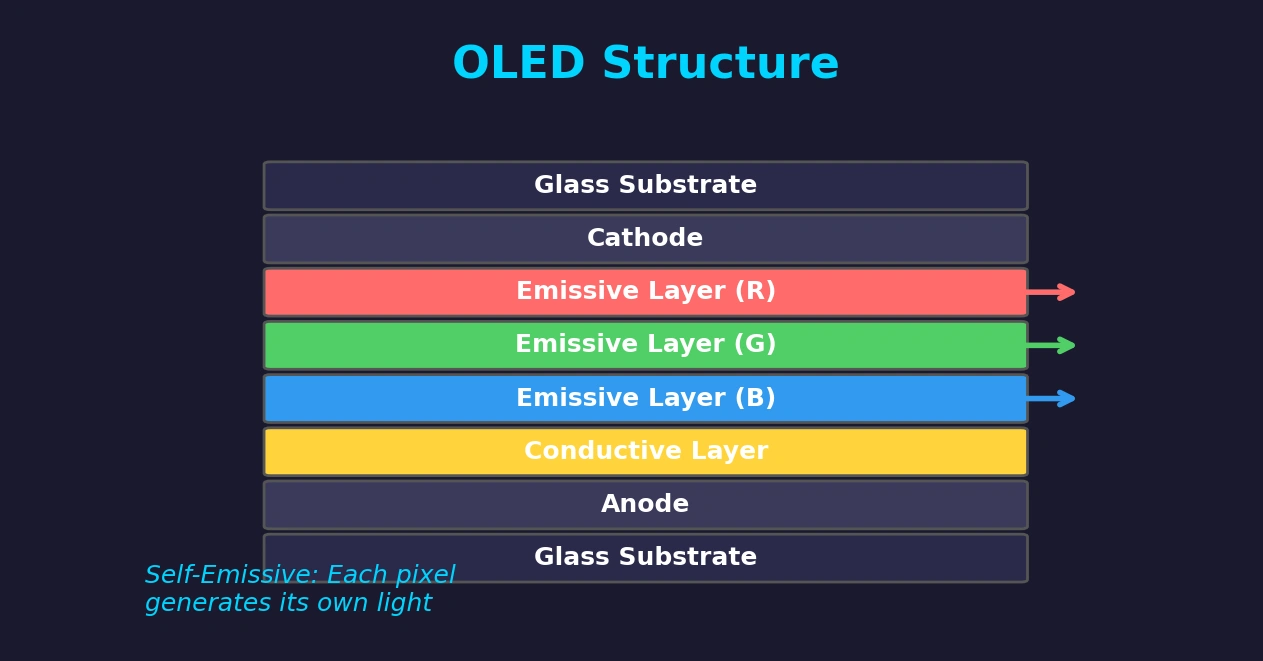
The fundamental difference between OLED and IPS lies in how they generate light. This distinction drives almost every performance characteristic you will notice in real-world use.
| Aspect | OLED Technology | IPS Technology |
|---|---|---|
| Working Principle | Each pixel contains organic compounds that emit light when an electric current passes through them. No separate backlight needed. | Liquid crystals rotate to allow varying amounts of backlight through. The backlight is always on; crystals act as shutters. |
| Black Level | Perfect black—pixels can turn completely off. | Backlight bleed means blacks appear dark gray, not true black. |
| Contrast Ratio | Theoretically infinite (1,000,000:1 or higher measured) | Typically 1,000:1 to 1,500:1 |
| Response Time | Under 1ms (often 0.1–0.5ms for gaming panels) | 4–8ms typical; fastest IPS panels reach 1–2ms |
| Color Gamut | Excellent; wide gamut coverage (DCI-P3, Rec. 2020) | Very good; covers sRGB and most of DCI-P3 on premium panels |
| Brightness | Lower peak brightness than high-end IPS; typically 400–600 nits sustained | Can sustain 400–600 nits; HDR models push 1,000+ nits |
| Viewing Angle | Near-perfect from any angle with no color shift | Excellent; minimal shift compared to older TN panels, though slight gamma shift can occur at extreme angles |
| Power Efficiency | Efficient for dark UIs and video; inefficient for full-white screens | Consistent draw; does not vary significantly by content |
| Main Weakness | Burn-in risk, organic degradation, higher cost | IPS glow, lower contrast, backlight uniformity issues |
Where Each Technology Shines: Application Industries
Neither technology is universally “better.” They simply fit different needs.
OLED dominates in:
- Smartphones and wearables — The thin profile, perfect blacks, and low power for dark interfaces make OLED ideal for portable devices.
- High-end TVs — Home theater enthusiasts prioritize contrast and black levels for cinematic viewing.
- Medical displays — Diagnostic imaging benefits from high contrast and true blacks.
- Automotive dashboards — Flexibility and high contrast in varying light conditions.
- Industrial HMI and portable instruments — Compact devices where readability and power efficiency matter.

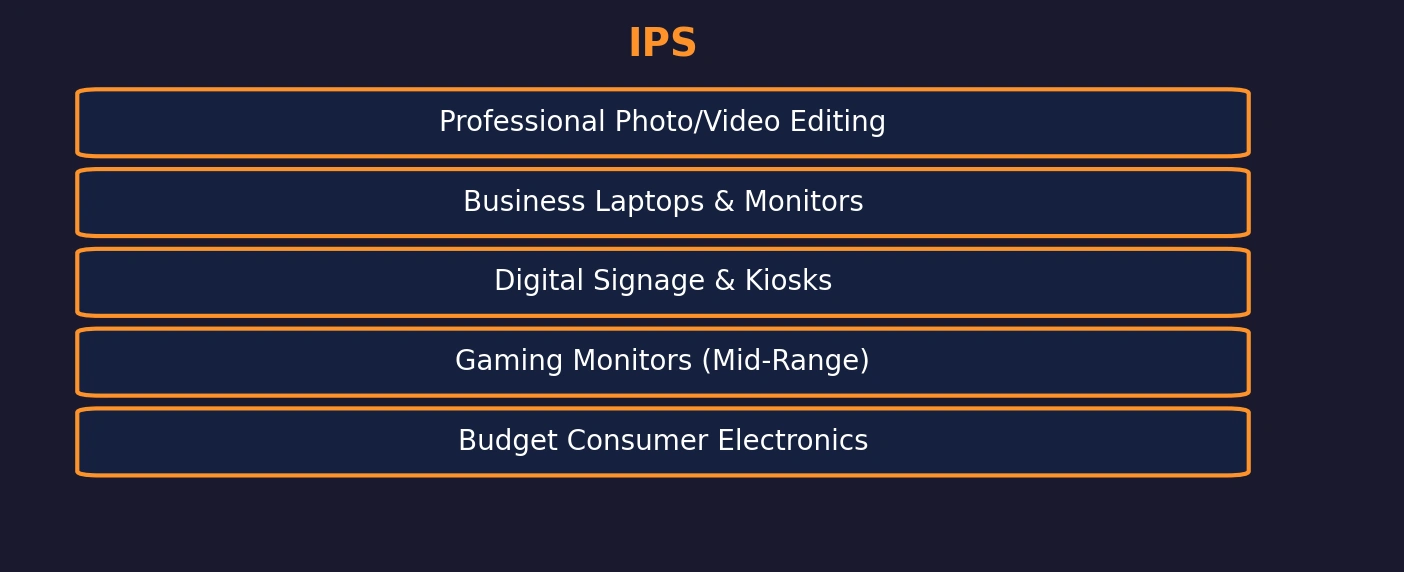
IPS leads in:
- Professional monitors and photo editing — Color accuracy and consistency over long sessions.
- Laptops and business displays — Longevity and no burn-in risk for static taskbars and spreadsheets.
- Digital signage and kiosks — 24/7 operation with static logos requires burn-in immunity.
- Gaming monitors (mid-range) — Fast IPS panels now offer competitive response times with better color stability than TN.
- Budget-conscious consumer electronics — Lower manufacturing cost without sacrificing decent color performance.
Deep-Dive Technical Comparison
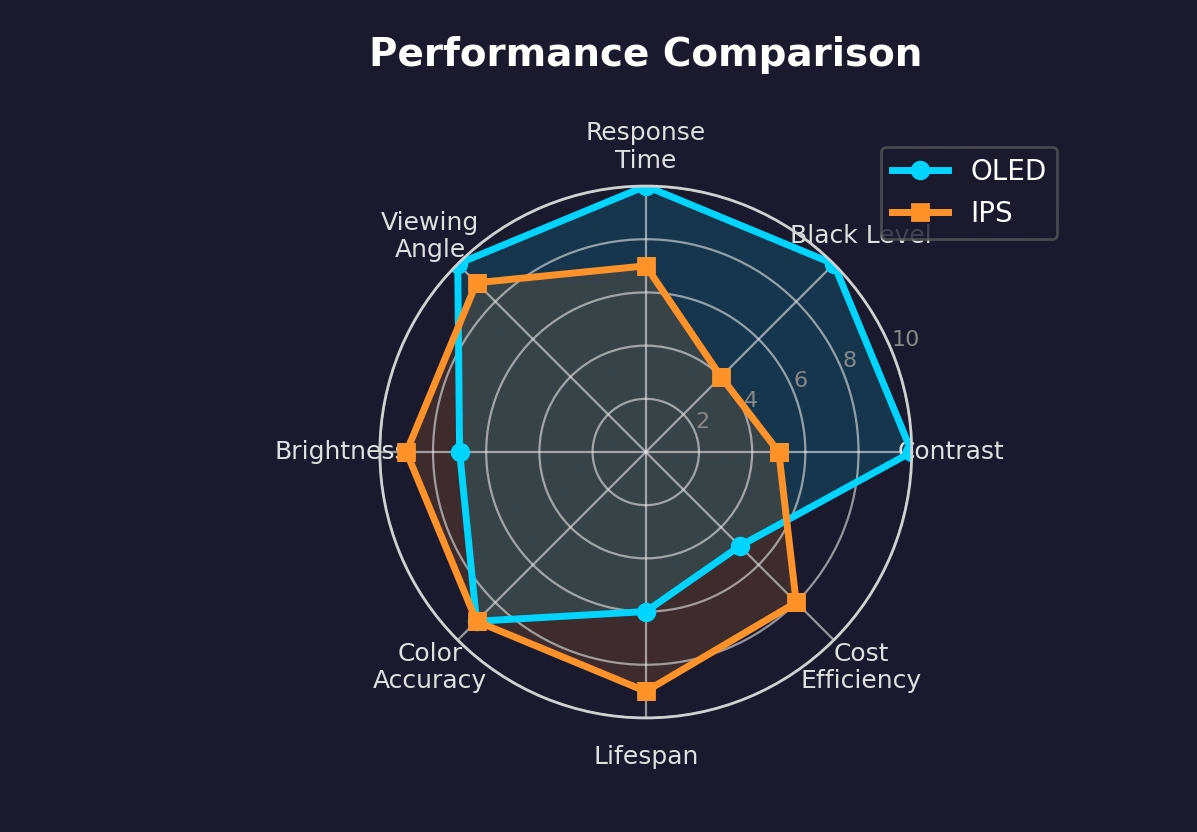
Let us get specific about the metrics that actually affect your viewing experience.
Black Levels and Contrast
OLED wins decisively here. Because individual pixels emit their own light, an OLED pixel displaying black is literally turned off. IPS cannot achieve this because the backlight is always active. Even with local dimming, IPS displays show some level of backlight bleed or “IPS glow” in dark rooms. If you watch movies in a dim environment, OLED provides a depth that IPS simply cannot match.
Image Quality and Color
Both technologies can produce excellent color. Premium IPS panels calibrated for professional work achieve Delta E values under 2, which is effectively perfect for human perception. OLED tends to look more vivid out of the box because of the contrast boost—colors appear to pop more against true black backgrounds. However, for print design and color-critical workflows, a well-calibrated IPS monitor is often preferred because it maintains consistent brightness and color over years of use.
Brightness
This is where IPS often pulls ahead. High-end IPS monitors and TVs with full-array local dimming can sustain 1,000 nits or more for HDR content. OLED brightness has improved significantly (modern panels hit 1,000+ nits in small windows), but sustaining high brightness across the entire screen can be limited by power constraints and organic material longevity. For bright office environments or HDR mastering, IPS currently holds practical advantages.
Motion Handling and Response Time
OLED response times are effectively instantaneous—under 1ms. This means virtually no motion blur in fast-paced gaming or sports. IPS has narrowed the gap considerably; the best gaming IPS panels now advertise 1ms response times, though in practice they often measure closer to 2–4ms in real-world transitions. For competitive gaming, OLED still holds an edge, but the difference is shrinking.
Viewing Angles
OLED maintains color and contrast perfectly even at extreme angles. IPS is very good—far better than older TN panels—but you may notice slight shifts in gamma or color temperature when viewing from the side. For multi-person viewing or unconventional mounting angles, OLED has a small but real advantage.
Text Clarity and Productivity
This is a nuanced area. IPS panels often render text more crisply because of the consistent subpixel structure. Some OLED displays (particularly those with subpixel layouts like RWBG) can show slight color fringing on fine text. For programmers, writers, and spreadsheet-heavy work, a high-quality IPS panel is often the more comfortable choice over an eight-hour workday.
Burn-in: The Real Concern
Burn-in is not a myth. If you display static elements—like a news ticker, taskbar, or HUD in a video game—for thousands of hours, OLED can retain a ghost image. Modern OLEDs employ pixel shifting, logo detection, and periodic refresh cycles to mitigate this, but the risk never fully disappears. IPS has no such vulnerability. If your application involves static content or 24/7 operation, IPS is the safer long-term investment.
JicTech: 23 Years of OLED Display Expertise
When sourcing OLED displays for industrial or commercial applications, working with an experienced manufacturer matters. JicTech has specialized in OLED display production and customization for 23 years. Their product range covers monochrome, dual-color, zone-color, and full-color OLED modules in sizes from 0.66 inches up to 3.12 inches and beyond, with non-standard sizes and flexible cutting supported.
JicTech offers integrated solutions including capacitive and resistive touch options, ambient light sensors, and custom interface configurations (I²C, SPI, parallel). Their displays serve wearables, medical instruments, industrial HMI panels, smart home devices, and automotive secondary displays. For teams building embedded systems or specialized equipment, a supplier with this depth of manufacturing experience can mean the difference between a prototype that works and a product that ships reliably.
FAQ: Who is better, OLED or IPS?
Is OLED better than IPS for gaming?
For fast-paced competitive gaming, OLED’s near-instant response time and perfect blacks provide a smoother, more immersive experience. However, if you play games with static HUD elements for long sessions, IPS avoids burn-in risk while still offering excellent performance on premium panels.
Which is better for eye strain, OLED or IPS?
Neither is inherently better. OLED can be easier on the eyes in dark rooms due to lower overall light emission. IPS may be preferable in bright offices because it can maintain higher brightness without flicker. Proper brightness calibration matters more than the panel type itself.
Do OLED screens last as long as IPS screens?
In typical mixed-use scenarios, modern OLEDs last years without noticeable degradation. However, for applications with static content displayed continuously—like digital signage or industrial monitors—IPS has a longer reliable lifespan due to zero burn-in risk.
Is IPS or OLED better for photo and video editing?
Professional colorists often prefer high-end IPS monitors for their color consistency and longevity. OLED is excellent for reviewing final HDR content due to its contrast capabilities, but for daily editing work where UI elements are static, IPS is the pragmatic choice.
Why are OLED TVs more expensive than IPS TVs?
OLED manufacturing involves more complex organic material deposition processes, lower yields on large panels, and more sophisticated drive electronics. IPS benefits from mature, high-volume LCD production lines that have been optimized over decades, resulting in lower costs at equivalent sizes.
Bottom line: There is no universal winner. OLED offers unmatched contrast and speed for premium experiences. IPS delivers reliability, consistency, and value for professional and commercial applications. Your specific use case—not the technology hype—should drive the decision.