









Overview
To be honest, the first time I actually sat down and ran the numbers, I was pretty surprised myself. Take a typical 15-inch industrial display panel—swap it out for a low-power version, and you’re looking at nearly 16 kilograms of CO2 saved per year. Doesn’t sound like much? Well, if you’re managing a production line, a workshop floor, or display terminals across an entire factory, that figure quickly balloons into tens or even hundreds of tons of carbon dioxide. This isn’t just a numbers game on your electricity bill; it’s a real environmental ledger.
For the display industry, the past decade or so has been all about bigger, brighter, sharper. But now, more and more procurement managers and product leads are asking a different set of questions: How much energy does this screen actually consume? How much carbon does it emit? How long will it last? Behind these questions lies the entire manufacturing sector’s response to “dual carbon” targets, and the hard reality of controlling operational costs.
What I want to talk about today is how low-power LCD display technology manages to save money and cut carbon at the same time—and how enterprises should approach procurement decisions. I’ll reference some actual product specs from Jictech (Jiesheng), a company that’s done solid work in the low-power LCD space, offering a complete low-power product line ranging from 2.66-inch e-paper displays all the way up to 32-inch industrial panels.
1. Where Exactly Is the “Low Power” in Low-Power LCD Technology?
When most people hear “low-power display,” their first thought is just dimming the brightness. That’s a misunderstanding. True low-power technology is a systems engineering effort that starts at the fundamental architecture level.
1.1 Power Control at the Panel Level
An LCD panel’s power consumption comes from two main parts: panel driving and the backlight system. Traditional TFT LCD panels need a continuous voltage applied to maintain the liquid crystal molecules’ deflection state, which itself consumes energy. Low-power panel technology reduces this loss through several approaches:
High aperture ratio pixel design is key. The aperture ratio refers to the proportion of each pixel that actually transmits light. The higher the ratio, the less backlight power you need to achieve the same brightness. Jictech’s 15-inch XGA panel (model JT150Y1N-M10) performs well here, with a typical panel power consumption of just 1.5W—quite impressive for an industrial screen of this size. Many conventional 15-inch industrial panels consume 3W or more on the panel alone, so this single improvement cuts power roughly in half.
Low-voltage driving is another direction. By optimizing the TFT array manufacturing process and reducing gate drive voltage and source drive voltage, you can significantly cut the panel’s dynamic power consumption. Jictech’s 9-inch TFT module (HS09001ATP50-27B) uses an a-Si TFT active matrix technology, keeping panel power consumption around 0.36W. Add in the LED backlight and the total is still only 2.56W. In portable medical devices or automotive display scenarios, this means battery life can essentially double.
1.2 The Energy Revolution in Backlight Systems
The backlight is where most of the power goes. On a typical LCD display, the backlight system accounts for 60% to 80% of total power consumption. So reducing backlight power is the core battlefield for carbon reduction.
LED backlight replacing CCFL was the first revolution the industry already completed. CCFL (cold cathode fluorescent lamp) contains mercury, consumes more power, and has a shorter lifespan—now basically obsolete. Jictech’s entire TFT LCD module lineup uses LED backlighting; that’s the baseline threshold.
High-efficiency LED chips represent the second round of optimization. Under the same brightness, new-generation LED chips are 20% to 30% more efficient than older ones. Jictech’s 32-inch FHD module (JS320FHM-NN0) achieves 400 cd/m² brightness, but through optimized LED driving schemes keeps overall power consumption at a low level, with a backlight lifespan reaching 30,000 hours. That means in industrial monitoring, digital signage, and other 24/7 operation scenarios, a single panel can run continuously for over three years without backlight replacement.
Dynamic backlight adjustment is a smarter solution. It adjusts backlight brightness in real time based on the darkness or lightness of the displayed content. Dark scenes automatically reduce backlight power; bright scenes boost it. This technology is fairly mature in phones and TVs, but in the industrial display space, companies like Jictech are also implementing it through customized solutions.
1.3 E-Paper: The “Zero Power” Solution for Extreme Scenarios
If low-power TFT LCD is about “careful budgeting,” then e-paper is about “hardly spending anything at all.”
Jictech’s 2.66-inch e-paper module (JS0266NQ04-A0) has a particularly interesting characteristic: bistable display. What does that mean? Once the image on the screen refreshes, even if you completely cut power, the image stays exactly as it was. During static display, power consumption is essentially zero—in deep sleep mode it’s only 1µW, with current as low as 1µA. It only draws about 120mW when actually updating the image.
I ran the numbers: assume an electronic shelf label updates 10 times a day, 3 seconds each time, with the rest in static display. That 2.66-inch e-paper panel’s annual carbon emission is just 0.000213 kg of CO2. What’s that mean? You emit more CO2 breathing out once than this thing does in a year.
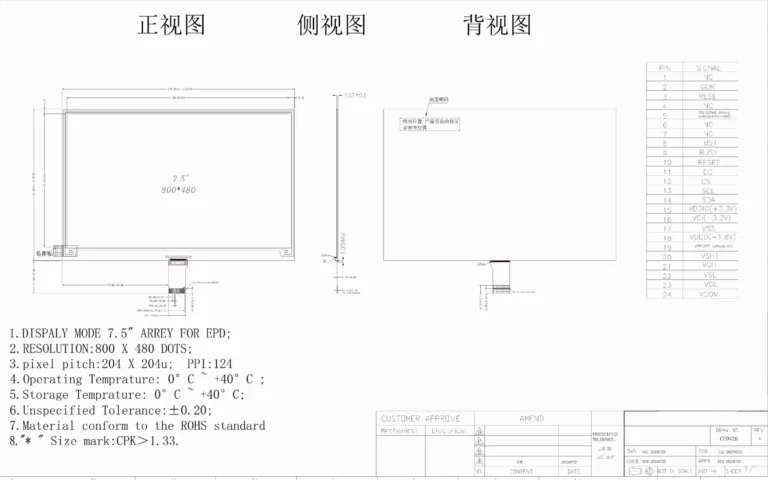
The 4.0-inch e-paper module (JS0400NW08-TNG-A0) also uses dual-static display technology with zero power to maintain the image, at just 0.81mm thickness and 480×800 resolution. In e-readers, smart retail labels, IoT displays—any scenario where refresh isn’t frequent—it’s pretty much the perfect zero-carbon display solution.
2. From Power Consumption to Carbon Footprint: Running the Real Numbers
Technical specs can feel abstract, so let’s do some real math. Carbon footprint calculation isn’t complicated; the key is looking at full-lifecycle energy consumption.
2.1 Annual Carbon Emission Comparison per Device
Using China’s average grid carbon emission factor of 0.5703 kg CO2/kWh (the latest 2024 data), assume an industrial display runs 12 hours a day, year-round:
| Size | Traditional Panel Power | Jictech Low-Power Panel | Annual Energy Saved | Annual CO2 Reduction | Energy Savings Ratio |
|---|---|---|---|---|---|
| 9-inch | ~5W | 2.56W | 10.69 kWh | 6.09 kg | 48.8% |
| 15-inch | ~15W | 8.72W | 27.51 kWh | 15.69 kg | 41.9% |
| 21.5-inch | ~15W | 5.0W | 43.80 kWh | 24.98 kg | 66.7% |
| 32-inch | ~50W | ~25W | 109.50 kWh | 62.45 kg | 50.0% |
Data source: Based on Jictech product datasheets and industry typical power consumption comparisons.
The 21.5-inch JH215IALKN-01 panel consumes only 4.5W (without OverDrive) to 5.0W (with OS driver)—very impressive for an FHD panel of this size. Traditional 21.5-inch industrial panels typically draw around 15W total, meaning simply switching to a low-power panel can slash two-thirds of energy use and carbon emissions.
2.2 Enterprise-Scale Deployment Carbon Reduction Potential
Individual numbers seem modest, but multiply by deployment scale and the effect becomes substantial:
- 100 units of 15-inch low-power panels: Annual reduction of 1.57 tons CO2, equivalent to planting 87 trees (calculated at 18 kg CO2 absorption per tree per year).
- 1,000 units of 9-inch low-power panels: Annual reduction of 6.09 tons CO2, equivalent to planting 339 trees.
- A mid-sized factory deploying 500 mixed low-power displays: Annual reduction of 15–20 tons CO2.
And this doesn’t even account for another hidden benefit: reduced cooling load. Lower display power means less heat generation, which in turn reduces air conditioning and cooling system energy consumption. In data centers, control rooms, and similar environments, this “chain reaction” often yields an additional 20% to 30% energy savings beyond the display’s own power reduction.
2.3 Life Cycle Cost (LCC) Analysis
Enterprise procurement can’t just look at purchase price; you need to see total cost of ownership across the full lifecycle. The electricity savings from low-power panels over their lifespan can often offset or even exceed any purchase price premium within just a few years.
Take Jictech’s 15-inch module as an example. Assume industrial electricity at 0.6 RMB/kWh and a backlight lifespan of 20,000 hours:
- Traditional 15-inch panel: 20,000 hours consumes 300 kWh, electricity cost 180 RMB.
- Jictech low-power 15-inch panel: 20,000 hours consumes 174.4 kWh, electricity cost 105 RMB.
- Per-unit electricity savings: 75 RMB.
For the 9-inch panel, savings are relatively smaller at about 29 RMB per unit, but at large deployment volumes it still adds up significantly. And this doesn’t even factor in lower failure rates and reduced maintenance costs from lower power and heat generation. Jictech’s industrial-grade modules operate from -20°C to +70°C, remaining stable in harsh environments, which means fewer unexpected shutdowns and replacement costs.
3. Jictech’s Low-Power Technology Matrix
Enough theory—let’s look at how Jictech actually implements these technologies in their products. The company covers multiple size segments from 1.5 inches to 32 inches, each with its own low-power design focus.
3.1 Industrial-Grade TFT LCD Low-Power Solutions
Jictech’s TFT LCD module lineup covers mainstream industrial display sizes, with low-power design as a consistent philosophy across the entire range:
9-inch HS09001ATP50-27B: Total power consumption 2.56W, with backlight at 2.2W and panel at just 0.36W. 800×480 resolution, 250 cd/m² brightness, operating temperature -20°C to +70°C. For in-vehicle displays, portable testing equipment, and industrial handheld terminals, this power level can essentially double battery life.
15-inch JT150Y1N-M10: Panel power consumption 1.5W, total with backlight 8.72W. The 1024×768 XGA resolution remains popular in industry because many legacy systems still use this interface. The 178° full-viewing-angle IPS panel, combined with RoHS environmental certification, makes it competitive in medical monitoring, control system terminals, and retail POS applications.
21.5-inch JH215IALKN-01: This is an Open Cell, giving OEMs and system integrators flexibility for custom backlight solutions. Panel power consumption 4.5W to 5.0W, contrast ratio up to 3000:1, and 8ms response time. For professional monitors, medical imaging equipment, and industrial control panels requiring high contrast and fast response, this power level is 30% to 50% lower than comparable competing products.
32-inch JS320FHM-NN0: A large-format solution targeting commercial digital signage and industrial monitoring. 400 cd/m² brightness, 1200:1 contrast ratio, and 30,000-hour backlight lifespan. Large-format panels are harder to control for power consumption, but Jictech achieves lower overall power through optimized LED backlight driving and panel circuit design, while maintaining RoHS compliance.
3.2 E-Paper: The Ultimate Ultra-Low-Power Solution
If TFT LCD is about “doing subtraction,” e-paper is about “rewriting the rules entirely.”
2.66-inch JS0266NQ04-A0: Update power consumption 120mW, deep sleep 1µW. Bistable zero-power image retention, 1.14mm thickness, 6.1g weight. This size is ideal for electronic shelf labels (ESL), smart retail price tags, and industrial sensor readout displays. A coin cell battery can keep it running for years.
4.0-inch JS0400NW08-TNG-A0: 480×800 resolution, just 0.81mm thick, dual-static display with zero power to maintain the image. Suitable for scenarios requiring more information display but infrequent refresh, such as warehouse logistics labels, medical equipment information panels, and smart home control interfaces.
E-paper’s limitations are also clear: slow refresh rate (full refresh about 2.8 seconds), inferior color performance compared to TFT LCD, and unsuitability for dynamic video. So when selecting, first clarify whether the application truly needs “zero-power static display” rather than blindly pursuing the lowest power number.
3.3 Customized Low-Power Services
Jictech also offers small-to-medium batch customization services, which matters a lot in the industrial sector. Different devices have vastly different display requirements, and standardized low-power solutions may not fully adapt.
Customization directions include:
- Interface adaptation: LVDS, MIPI, RGB, SPI, etc., matching the host system’s low-power data interfaces.
- Backlight adjustment: Customizing LED backlight power and color temperature based on ambient brightness, avoiding energy waste from “over-illumination.”
- Mechanical optimization: Thinner bezels, optimized thermal structures, reducing overall device power consumption.
- Firmware tuning: Adjusting refresh rates and drive timing to find the optimal balance between image quality and power consumption.
4. Green, Environmentally Friendly, and Sustainable: More Than Just Slogans
The value of low-power technology can’t be measured by electricity bills alone. Behind it lies a complete philosophy of sustainable manufacturing and circular economy.
4.1 RoHS Compliance and Hazardous Substance Elimination
Jictech’s entire TFT LCD module lineup complies with RoHS standards. This means restricted substances (lead, mercury, cadmium, hexavalent chromium, polybrominated biphenyls, polybrominated diphenyl ethers) are strictly limited. For device manufacturers exporting to EU and US markets, this is an entry threshold; for enterprises focused on ESG reporting, this is foundational data for supply chain greening.
E-paper modules also meet RoHS standards, and because of their simple structure and minimal material usage, they reduce environmental burden starting from the production stage.
4.2 Longer Lifespan = Less E-Waste
The longer a display lasts, the less frequently it needs replacement, and the less electronic waste is generated. Jictech’s LED backlight design lifespan reaches 20,000 to 30,000 hours, which under industrial usage intensity (12 hours per day) means stable operation for 4 to 7 years without replacement.
Compare this to consumer-grade displays with backlight lifespans of just 3,000 to 5,000 hours—industrial-grade low-power modules last 4 to 6 times longer. This means over the device’s entire lifecycle, the display may never need replacement, fundamentally reducing electronic waste generation.
4.3 Packaging and Logistics Carbon Reduction
Don’t underestimate packaging. Traditional display packaging uses large amounts of foam plastic and non-degradable materials. Jictech has optimized product packaging, using recyclable materials and compact designs to reduce shipping volume and weight, indirectly lowering carbon emissions from logistics.
While this portion of emission reduction isn’t as significant as the product use phase, the philosophy of “full-lifecycle carbon reduction” should cover every stage from raw material procurement, manufacturing, transportation and distribution, use and maintenance, to recycling and disposal.
5. Application Pathways for Low-Power LCD Display Technology
Good technology is worthless if it can’t be deployed. Where exactly are low-power LCD panels most suitable? Based on Jictech’s product line and industry trends, here are the most typical application scenarios.
5.1 Industrial Automation and HMI Panels
Industrial Human-Machine Interface (HMI) is one of the “main battlegrounds” for low-power LCD panels. Factory floor operator panels, PLC control terminals, and equipment status monitoring screens often need to stay on 24/7, but display relatively static content (parameters, charts, status indicators).
Jictech’s 9-inch to 15-inch TFT LCD modules, with power consumption controlled between 2.56W and 8.72W, save 40% to 50% compared to traditional industrial panels. For a production line with dozens of devices, the annual electricity savings and carbon reduction are substantial. And the wide-temperature design (-20°C to +70°C) ensures reliability in harsh workshop environments.
5.2 Medical Equipment and Portable Instruments
Medical devices have special display requirements: clear readability, extended battery life, and regulatory compliance.
Jictech’s 2.1-inch to 10.1-inch modules are widely used in portable medical devices (patient monitors, diagnostic tools, handheld terminals). The low-power characteristics of MIPI interfaces, wide viewing angles of IPS panels, and high-contrast design let medical staff accurately read data from various angles and lighting conditions. And low power means devices can be made lighter, with smaller batteries, or simply extended single-charge usage time.
5.3 Smart Retail and Electronic Shelf Labels
This is where e-paper really shines. Supermarkets and convenience stores’ electronic shelf labels (ESL) may only update pricing once or twice a day, with the rest of the time completely static. Traditional LCD panels in this scenario are like “using a cannon to kill a mosquito”—continuously consuming power to maintain an unchanging image.
Jictech’s 2.66-inch and 4.0-inch e-paper modules have zero power consumption during static display, only drawing power instantaneously during updates. A large supermarket deploying thousands of ESL tags has virtually negligible annual carbon emissions. And e-paper’s paper-like display quality remains clearly readable in sunlight, making it more suitable than LCD for retail floor environments.
5.4 In-Vehicle Displays and Transportation Information Screens
The in-vehicle environment is extremely demanding on displays: wide temperature range, vibration resistance, high reliability, and low power. Car batteries have limited capacity, and excessive display power directly impacts range or increases alternator burden.
Jictech’s 9-inch module covers -20°C to +70°C operating temperature with total power consumption of just 2.56W, making it competitive for in-vehicle instrumentation, rear entertainment systems, and navigation displays. For electric vehicles, every watt of power saved translates to a few more kilometers of driving range.
5.5 IoT and Smart Home
IoT devices are typically battery or solar powered, making them extremely sensitive to power consumption. Jictech’s 1.5-inch OLED module has a sleep current of just 0.5µA, and the 2.7-inch OLED module 2µA—in smart door locks, temperature and humidity sensors, and smart switch panels, this can extend battery life from months to years.
E-paper applications in smart home control panels are also growing. Room status displays, energy consumption monitoring panels—information that doesn’t update frequently—is perfectly suited for e-paper, saving power while looking elegant.
5.6 Commercial Digital Signage and Public Transportation
32-inch and larger displays traditionally consume 50W to 100W. Jictech’s 32-inch FHD module achieves lower power consumption through optimized backlight and panel design, while maintaining 400 cd/m² high brightness and 30,000-hour backlight lifespan.
In subway stations, bus stops, and mall wayfinding screens—public facilities that need long-duration operation—the energy-saving effect of low-power large screens is most pronounced. A single 32-inch panel can reduce 62 kg of CO2 annually; if a city’s subway system deploys thousands of units, annual reductions can reach dozens of tons.
6. How Enterprises Should Select Low-Power LCD Display Technology Solutions
As a procurement lead or product manager, facing all sorts of “low-power” marketing claims on the market, how do you choose solutions that truly reduce costs and carbon? I’ve summarized some practical selection principles.
6.1 Clarify Power Test Conditions
When manufacturers quote power consumption figures, always check the test conditions. Was it measured on an all-white screen? Or a typical image? With or without backlight? What refresh rate? What operating temperature?
Jictech’s product datasheets typically specify test conditions. For example, the 15-inch module’s 1.5W panel power is measured under typical operating conditions, and the 21.5-inch Open Cell’s 4.5W is measured under white pattern at 60Hz conditions. These details determine whether the data is actually comparable.
6.2 Distinguish “Panel Power” from “Total Power”
Some manufacturers only label panel power consumption, which looks low, but total power with backlight may double. Jictech’s product pages typically label both panel power and total power with backlight separately. For example, the 9-inch module clearly states “total power consumption 2.56W (panel + backlight)”—this transparency matters.
6.3 Look at Full Lifecycle Cost, Not Purchase Price
Low-power panels may cost 10% to 20% more upfront, but factoring in electricity savings and reduced maintenance costs over years of operation, total cost of ownership (TCO) is often lower.
Take the 15-inch module as an example: over a 20,000-hour lifespan, electricity savings are 75 RMB. If the purchase price difference is under 50 RMB, the low-power solution is cost-effective from day one. If the difference is around 100 RMB, payback typically occurs within 1 to 1.5 years through electricity savings alone.
6.4 Match the Application Scenario, Don’t Blindly Pursue Lowest Power
Not every scenario calls for the most extreme low-power solution. E-paper has the lowest power but slow refresh and can’t display video—using it for real-time industrial HMI monitoring would be inappropriate. TFT LCD consumes more power than e-paper but has fast response and good color, making it suitable for dynamic content.
Jictech’s product line covers multiple technology routes from e-paper to TFT LCD to OLED. When procuring, select the most appropriate technology based on refresh frequency, display content type, ambient lighting, and power supply method, rather than simply comparing power consumption numbers.
6.5 Verify Environmental Certifications and Reliability Testing
Low power is just one aspect of green attributes. Also check compliance with RoHS, REACH, and other environmental regulations, and whether products have passed high/low temperature, humidity, vibration, and ESD reliability testing.
Jictech’s industrial-grade modules typically undergo -20°C to +70°C high/low temperature operation testing, thermal shock cycling, vibration and mechanical shock testing, and ESD protection testing (±2kV to ±8kV). These tests ensure that low power doesn’t come at the cost of reliability.
6.6 Consider Supply Chain Sustainability
Finally, a point that more enterprises are beginning to focus on: the green manufacturing capabilities of the supplier itself. While Jictech as a mid-sized module manufacturer doesn’t have the massive ESG reporting systems of BOE or TCL CSOT, its RoHS-compliant products, support for small-batch customization to reduce waste, and provision of long-life products to reduce replacement frequency are all concrete manifestations of supply chain greening.
7. Conclusion: The Green Future of Display Technology
The value of low-power LCD display technology goes far beyond “saving a bit of electricity.” It represents a new product design philosophy: minimizing energy consumption and environmental impact while meeting functional requirements.
From Jictech’s product specifications, we can see this philosophy in action: 9-inch panel at 2.56W total, 15-inch panel at 1.5W, e-paper deep sleep at 1µW, 32-inch backlight lifespan at 30,000 hours… Behind these numbers lies comprehensive coordination across panel design, backlight optimization, drive circuitry, material selection, and manufacturing processes.
For enterprise procurement professionals, choosing low-power display solutions is both a practical response to national “dual carbon” strategies and an effective means of reducing operational costs. A single panel reduces 6 to 60 kg of CO2 annually; a thousand panels means 6 to 60 tons. This is a calculation worth taking seriously.
The green transformation of the display industry is just beginning. As new technologies like IGZO oxide semiconductors, LTPO dynamic refresh, and Micro LED gradually mature, future displays may deliver even better image quality with even less energy. But regardless of how technology evolves, the core principles of “low power, long life, recyclable” will remain essential criteria for what makes a good display.
FAQ: Common Questions About Low-Power LCD Display Technology and Carbon Footprint
Q1: Can low-power LCD panels really significantly reduce enterprise carbon footprint? How much exactly?
A: Yes, and the effect is quite noticeable. In real numbers, a Jictech 15-inch low-power industrial panel can reduce about 15.7 kg of CO2 emissions per year compared to traditional solutions; a 21.5-inch panel can achieve up to 25 kg CO2 annual reduction. If an enterprise deploys 100 units of 15-inch panels, that’s 1.57 tons of CO2 saved annually—equivalent to planting 87 trees. Large-format digital signage applications are even more impactful, with a single 32-inch panel reducing 62 kg of CO2 per year. The key point is these reductions require no changes to usage habits—just swap the panel.
Q2: How does Jictech’s low-power LCD technology perform in reducing procurement and operational costs?
A: On the procurement side, Jictech supports small-to-medium batch customization, avoiding unnecessary bulk-order premiums for low-power features. On the operational side, a 9-inch panel can save approximately 29 RMB per unit in electricity over a 20,000-hour lifespan, while a 15-inch panel saves about 75 RMB per unit. More importantly, low power means less heat generation, which also reduces equipment failure rates and maintenance costs. Combined with LED backlight lifespans of 20,000 to 30,000 hours, replacement frequency drops, further saving labor and material costs.
Q3: How does e-paper display achieve “zero power,” and what applications is it suitable for?
A: E-paper uses electrophoretic display technology. Images are formed by the physical movement of charged microcapsules; once refreshed, the microcapsules hold their position, so no continuous power is needed to maintain the image. Jictech’s 2.66-inch e-paper has a deep sleep power consumption of just 1µW, with virtually zero carbon emissions during static display. It’s best suited for low-refresh, infrequently changing information scenarios such as electronic shelf labels (ESL), warehouse logistics labels, smart price tags, and industrial sensor readouts. However, it’s not suitable for video playback or interfaces requiring rapid interaction.
Q4: What are the most commonly overlooked key points when enterprises procure low-power display solutions?
A: Three things are most easily overlooked: First, looking only at panel power while ignoring total power consumption—the backlight is where most power goes, so always compare complete power figures including backlight. Second, ignoring lifecycle costs—low-power panels may have slightly higher purchase prices, but electricity savings typically pay back within 1 to 2 years. Third, mismatched technology selection for the application—e-paper has the lowest power but slow refresh; TFT LCD is good for dynamic content; OLED is suitable for small portable devices. Choosing the wrong technology route actually undermines expected results.
Q5: Beyond energy savings and carbon reduction, what other environmental aspects of low-power LCD panels are worth paying attention to?
A: At least three other dimensions matter. First, material environmental friendliness—for example, Jictech’s entire product line complies with RoHS standards, restricting hazardous substance use. Second, extended lifespan reducing e-waste—industrial-grade modules with 20,000 to 30,000-hour backlight lifespans last 4 to 6 times longer than consumer-grade panels, significantly reducing replacement frequency and disposal volume. Third, full-chain carbon reduction, including compact packaging to reduce logistics emissions, optimized thermal design to lower air conditioning energy use, and customization support to avoid resource waste from functional redundancy. True green display is full lifecycle management from design to recycling.