







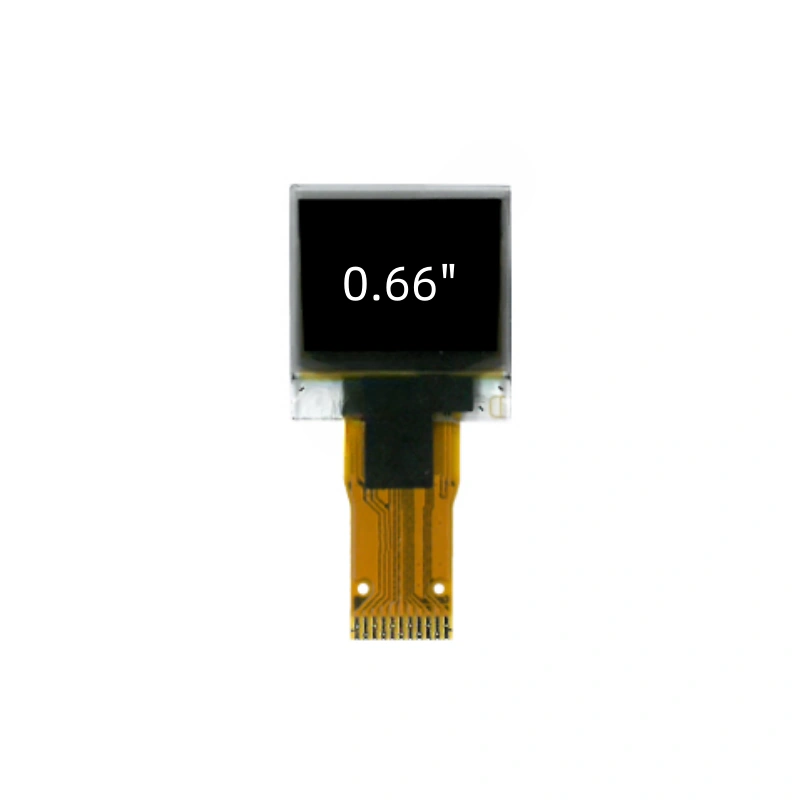
The 0.66-inch 64×48 PMOLED (JS0660003A) is a compact monochrome status display for products that need a readable value without a full graphical screen. It uses a passive-matrix OLED panel, so there is no backlight and no minimum backlight thickness. The 64×48 matrix is intended for short labels, icons and a few digits; it is not a video or multi-colour display.
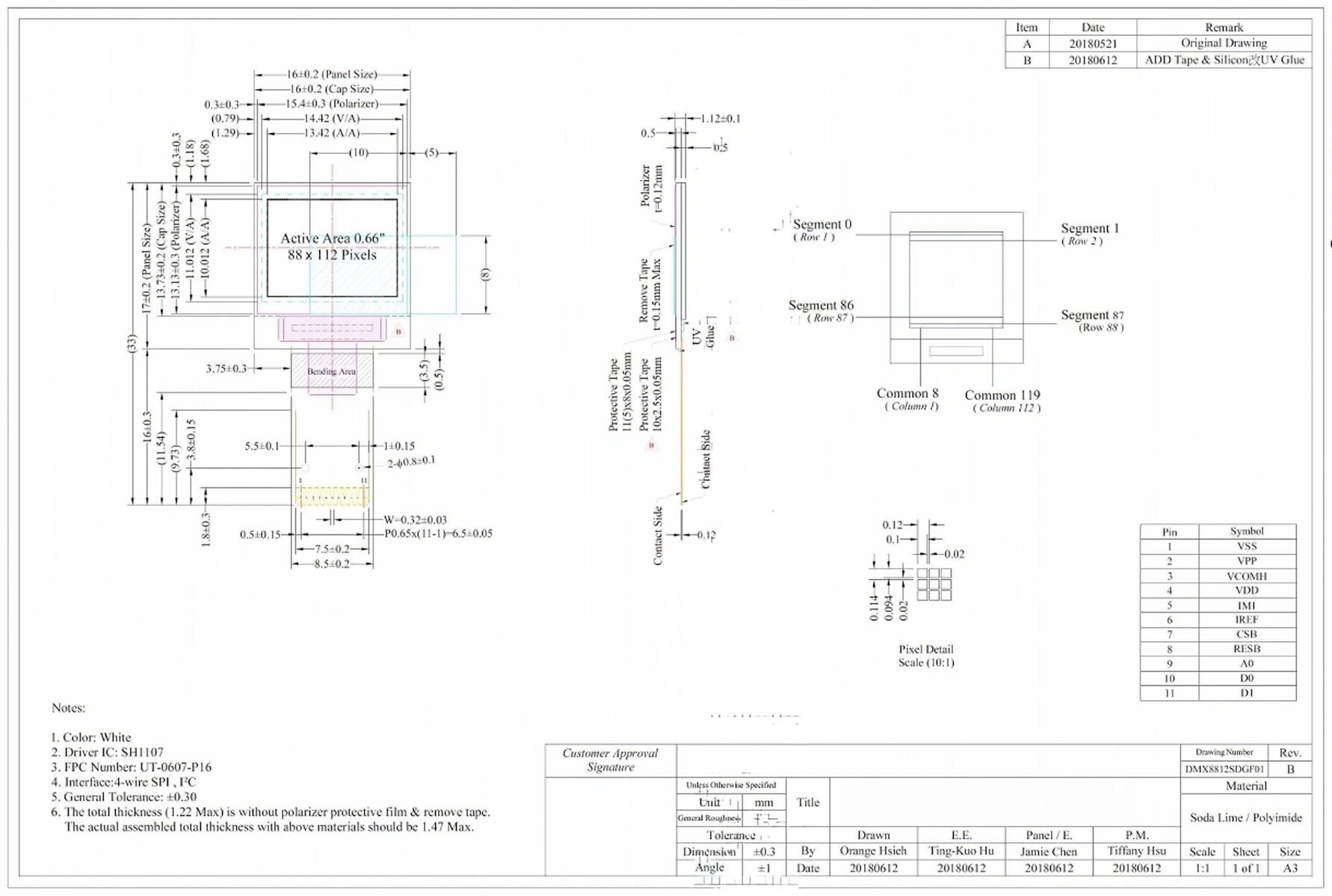
This variant is intended for a small instrument or appliance panel with a fixed UI. The exact driver IC, interface, outline and FPC pinout depend on the part-number revision. Use the downloadable datasheet for the electrical and mechanical values, and confirm the revision before layout.
Applications: where a 0.66-inch display fits
This size is a good middle ground between a tiny 0.29–0.49-inch status window and a 0.96-inch text display. The 64×48 matrix gives enough room for a value plus a short label, but keeps the module small enough for a handheld enclosure.
| Aplicación | Why 0.66-inch 64×48 fits | Design note |
|---|---|---|
| Portable instrument | Short measurement plus unit | Define the character height before choosing the window |
| Battery charger / power bank | Voltage, current or charge state | Use a fixed layout; avoid scrolling text |
| Smart-home control | Mode, setpoint or status | Keep icons large and the background mostly off |
| Handheld tool / tester | Compact status and battery gauge | Add an ESD-safe window and a mechanical stop |
| Appliance panel | Single-colour mode indication | Check the cover-glass tint against the chosen colour |
| Wearable / portable device | Small module and low-power sleep | Confirm the FPC bend and the enclosure depth |
These are application examples, not a certification or customer reference.
Mechanical and interface planning
The 0.66-inch class is small enough that the FPC and connector often decide the enclosure more than the glass itself. Before tooling, check:
- the exact module outline and active-area position;
- the FPC exit direction, length and bend radius;
- the connector pitch and pin-1 orientation;
- the cover-glass thickness and the air gap or optical bonding;
- the space needed for the charge-pump capacitors and I²C/SPI pull-ups.
Do not copy the FPC footprint from a different 0.66-inch variant. The part-number suffix can change the driver, interface or pinout.
What to confirm in the datasheet
| Field | Por qué es importante |
|---|---|
| Resolution and active area | Character height and usable UI area |
| Conductor IC | Command set and initialization sequence |
| Interfaz | I²C, SPI or parallel; host pin count |
| Module and panel outline | Enclosure, window and FPC clearance |
| Brightness and CIE | Optical match and cover-glass choice |
| Operating/storage temperature | Environment and polariser limits |
| FPC pinout | Connector, reset and power sequencing |
| Reliability and lifetime | Test conditions, not just a headline number |
The downloadable PDF is the authoritative source for these values. This page intentionally does not repeat unverified numbers.
Reliability and quality planning
Ask for the current reliability matrix for the exact part number: high/low-temperature operation, high-temperature storage, humidity, thermal shock, vibration and ESD. Check whether the samples include the polariser and the final adhesive stack. A generic “industrial grade” statement is not a test report.
Customization options
| Option | What can be reviewed |
|---|---|
| FPC | Length, pinout, bend direction and connector |
| Cristal protector | Thickness, AG/AR/AF treatment and print |
| Bonding | Air gap, OCR or OCA |
| Brightness / temperature | Target values and validation plan |
| Packaging | Tray, reel or custom packing |
PREGUNTAS FRECUENTES
Is this a colour display?
No. It is a monochrome PMOLED. Use an RGB OLED or TFT for multi-colour UI.
What interface does it use?
It depends on the exact part-number revision. Confirm the interface and driver IC in the datasheet before layout.
Does it need a backlight?
No. PMOLED is self-emissive; black pixels switch off.
Can I use it outdoors?
It has high contrast, but sunlight readability depends on brightness, cover glass and reflections. Test the final stack.
Can the FPC be customized?
Length, pinout and bend direction can be reviewed for volume projects; tooling and MOQ must be confirmed.
Where is the full specification?
Download the PDF datasheet below. Confirm the revision and part-number suffix before design freeze.
Ordering and customization
Order by the full part number, including the suffix. The 0.66-inch platform can be reviewed for FPC length, connector, cover-glass treatment, packing and brightness targets; each change needs a drawing and a validation plan. Do not order from the diagonal size alone.
Integration checklist
- Confirm the exact part-number suffix and datasheet revision.
- Check the FPC pinout, connector pitch and pin-1 orientation.
- Place charge-pump capacitors close to the FPC; keep the loop short.
- Measure sleep and active current with the real UI pattern.
- Test the final cover glass, polariser and adhesive stack at the target temperature.
- Define the UI before tooling: character height, icons and blank background.
Datasheet
Reviewed by JicTech Engineering Team · Last updated: November 2026
This page is a selection guide. The attached datasheet is the controlling document for mechanical, electrical and optical values.