








Overview
If you’ve ever tried to read a car navigation screen under the midday sun, or squinted at an industrial device display on an outdoor job site, you know exactly what I’m talking about—ordinary LCD screens are practically useless in bright sunlight. The content gets washed out by the light, contrast drops off a cliff, and before you know it, your screen has turned into a mirror. This isn’t just an annoyance; in industrial control systems, vehicle dashboards, and outdoor navigation setups, not being able to read the screen can directly impact safety.
So what exactly is sunlight doing to an LCD screen? And how do engineers use a range of precision technologies to keep displays readable even under blazing sun? Let’s dig into it.
Part 1: What Kind of Trouble Does Bright Light Actually Cause for LCD Screens?
To solve a problem, you first need to understand your enemy. Sunlight attacks LCD screens on three main fronts:
1. Ambient Light Overwhelms the Screen’s Own Brightness
A typical indoor LCD screen puts out about 200–400 nits (a nit is a unit of brightness). That’s perfectly fine under office lighting. But direct midday sunlight can reach 100,000 lux—hundreds of times brighter than indoor lighting. When the ambient light far exceeds what the screen itself can produce, the on-screen content is like a candle next to a spotlight—it simply gets swallowed whole.
2. Surface Reflections Create Glare
An LCD screen is made up of multiple layers: a protective glass on top, a liquid crystal panel in the middle, and a backlight module behind it. Every interface between glass and air, or glass and liquid crystal, reflects a portion of incoming light. When sunlight hits the screen, roughly 4%–8% of light reflects off each air-glass interface. These reflections create blinding glare that further masks whatever the screen is trying to display.
3. Contrast Falls Off a Cliff
LCDs work by twisting liquid crystal molecules to control how much backlight passes through, creating different shades of gray. But under strong ambient light, even when the crystals are fully “closed” to display black, some environmental light still penetrates the liquid crystal layer and gets reflected back by the backlight module. This means black is no longer truly black, while white gets diluted by the surrounding light. The result is a dramatic collapse in contrast—the screen looks hazy and washed out, text edges blur, and fine details vanish.
Stack these three problems together, and you get that familiar “screen-turned-mirror” effect we all dread outdoors.
Part 2: The Engineer’s Toolkit: Technologies That Keep LCDs Readable in Sunlight
The display industry hasn’t been sitting idle. After more than two decades of technical evolution, engineers have developed a fairly mature arsenal of countermeasures. These solutions rarely work in isolation—they’re typically deployed in layers, each addressing a different aspect of the problem.
Solution 1: High-Brightness Backlight—Using “Strong Light to Counter Strong Light”
The most straightforward approach is brutally simple: if the sun is too bright, make the screen brighter.
This is the core logic behind High-Brightness LCDs. Consumer-grade screens top out around 300 nits, but outdoor-rated displays can hit 1,000 nits, 2,000 nits, or even 5,000 nits and beyond. Some military-spec and specialized industrial displays push 10,000 nits at peak brightness.
Achieving these numbers isn’t just a matter of cranking up the LED power. It requires a complete optical engineering overhaul:
- High-Density LED Arrays: More efficient LEDs packed tighter together, with precision optical design to ensure uniform brightness across the panel without hot spots or dark corners.
- Enhanced Light Guide Plates (LGP): Special optical-grade acrylic materials with micro-structured dot patterns that convert point-source LEDs into uniform surface lighting while minimizing optical loss.
- Multi-Layer Optical Films: Reflective films, brightness enhancement films (BEF), and diffusion films are layered into the backlight module. These micro-structured optical layers “recycle” light that would otherwise be wasted and redirect it toward the viewer.
Of course, high brightness comes at a cost: power consumption and heat generation spike dramatically. A 2,000-nit outdoor screen might consume 5–8 times the backlight power of a standard indoor display. That’s why high-brightness solutions almost always require robust thermal management—metal heat spreaders, temperature-controlled fans, and in extreme cases even liquid cooling.
Solution 2: Optical Bonding—Eliminating the “Air Enemy”
Look closely at a standard LCD screen, and you’ll notice an air gap between the protective glass and the liquid crystal panel. This gap seems harmless, but it’s actually an optical saboteur.
When light travels from glass into air, the difference in refractive index (glass ≈ 1.5, air ≈ 1.0) causes Fresnel reflection at the interface. The internal reflections created by this air gap produce a foggy or ghosting effect under bright light, severely degrading contrast.
Optical bonding solves this by replacing that air gap with optically clear adhesive—typically either OCA (Optically Clear Adhesive) dry film or OCR (Optically Clear Resin) liquid resin—directly laminating the cover glass or touch panel to the LCD panel.
The benefits are substantial:
- Eliminates Internal Reflections: Without air-glass interfaces, internal reflections drop by 10%–15%, significantly boosting contrast in bright conditions.
- Increases Perceived Brightness: With less light lost to internal reflection, the same backlight power appears 15%–20% brighter to the viewer. You get better visuals with lower power.
- Enhances Structural Integrity: The adhesive layer bonds glass and panel into a single unit, dramatically improving impact resistance. It also blocks moisture and dust from entering the gap—a critical advantage for outdoor and automotive applications.
- Improves Touch Experience: For touchscreens, optical bonding eliminates the parallax caused by air gaps, making touch response feel more precise and natural.
For any display intended for outdoor or high-brightness use, optical bonding has shifted from “nice to have” to “absolutely essential.”
Solution 3: Anti-Reflection and Anti-Glare Coatings—Optical Armor for the Screen
Even with internal reflections eliminated, the outermost glass surface still faces direct sunlight. A 4% reflection rate might sound minor, but under 100,000 lux of direct sun, that 4% is more than enough to create blinding glare.
Engineers deploy two types of “optical armor” on the outer glass:
AR Coating (Anti-Reflection)
This involves depositing multiple nanometer-thin layers of metal oxides (typically alternating TiO₂ and SiO₂) on the glass surface. Using the principle of optical interference, these layers cause reflected light waves to cancel each other out. Quality AR coatings can drop surface reflectivity from 4% to under 0.5%—approaching “invisible glass” territory. In practical terms, that means reducing glare intensity by nearly 90%.
AG Treatment (Anti-Glare)
While AR coatings tackle reflection intensity, AG treatments tackle reflection direction. Through chemical etching or sandblasting, the glass surface is given a micro-textured finish that converts mirror-like specular reflections into soft, diffuse reflections. Any remaining reflected light is scattered rather than focused into a blinding hotspot.
In real-world products, AR and AG are often combined: AR on the inner surface to minimize reflections, AG on the outer surface to soften what little remains. Premium outdoor displays may also incorporate UV/IR blocking layers to filter out ultraviolet and infrared radiation, protecting liquid crystal materials from aging while reducing heat absorption.
Solution 4: Transflective LCD—The Smart Approach of “Borrowing” Sunlight
If high-brightness displays represent brute force—overpowering the sun with more light—Transflective LCDs represent a smarter, more energy-efficient philosophy: if sunlight is so abundant, why not use it?
The core of a transflective LCD is a transflector layer built into the liquid crystal panel. This layer acts like a one-way mirror: backlight can pass through it to illuminate the screen (transmissive mode), while ambient light can be reflected off it to also illuminate the screen (reflective mode).
What this means in practice:
- In dark environments: The backlight operates normally, delivering full-color performance identical to conventional LCDs.
- In bright sunlight: The backlight can be dimmed or even turned off entirely. Sunlight hits the transflector, bounces back through the liquid crystals, and “borrows” the sun as a light source. The brighter the ambient light, the brighter and clearer the screen appears.
This “borrowed light” design offers compelling advantages:
- Ultra-Low Power Consumption: During daytime outdoor use, backlight power can be drastically reduced or eliminated. For battery-powered devices, vehicle dashboards, and field instruments, this translates to several times longer battery life.
- No Additional Heat: Without a high-brightness backlight generating waste heat, reliability in hot environments improves dramatically, and complex cooling systems become unnecessary.
- True All-Environment Adaptability: One device automatically remains readable from a dimly lit room at night to direct midday sun—no manual adjustment needed.
Transflective LCDs do involve trade-offs. In pure reflective mode, color saturation and contrast are slightly lower than in full transmissive mode. The transflector layer also adds manufacturing complexity and cost. But for applications that frequently transition between indoor and outdoor use, and where power consumption is critical—industrial handheld terminals, field measurement instruments, military tablets—transflective technology is often the optimal choice.
Solution 5: Intelligent Brightness Adjustment and Ambient Light Sensing—Teaching Screens to Adapt
Even the best hardware falls flat if the screen blinds you at dusk and disappears at noon. That’s why modern sunlight-readable LCDs almost universally incorporate ambient light sensors and intelligent brightness algorithms.
These sensors continuously monitor surrounding light levels and dynamically adjust backlight brightness: dimming automatically when you step into shade to save power, ramping up instantly when you face the sun to maintain readability. Advanced systems even integrate temperature sensors, intelligently throttling backlight power when the screen overheats while maintaining minimum readable levels.
This adaptive capability doesn’t just improve user experience—it significantly extends the lifespan of LED backlights and liquid crystal panels, since running at full throttle 24/7 is a primary driver of component aging.
Solution 6: Wide-Temperature Liquid Crystals and Thermal Management—Surviving the Heat
Bright sunlight usually brings heat. A car dashboard on a summer day can easily exceed 60°C internally, while consumer-grade LCDs typically top out at 50°C–60°C operating temperature. Beyond this threshold, liquid crystal materials undergo phase changes, response times slow dramatically, and permanent damage or “black screen” failure can occur.
Industrial-grade sunlight-readable LCDs must use wide-temperature liquid crystal formulations, paired with heat-resistant polarizers, driver ICs, and optical adhesives, to guarantee operation across -30°C to +85°C or wider ranges. Thermal management technologies—metal heat spreaders, graphene thermal films, and even micro heat pipes—are integrated directly into the display module.
Part 3: How Are These Technologies Combined in Real Products?
So how do you actually choose when building a product? It usually comes down to matching the technology stack to the application scenario:
Vehicle Dashboards and Navigation: Need all-day indoor/outdoor readability, compact space, and power efficiency. Typical configuration: IPS wide-viewing-angle panel + 1,000–1,500 nits high-brightness backlight + optical bonding + AR/AG coatings + auto-brightness adjustment. Some premium vehicles opt for transflective solutions to further reduce power draw.
Outdoor Industrial Control Panels: Factory floors or field equipment facing direct sun, dust, and rain. Typical configuration: 1,500–2,500 nits high brightness + full optical bonding + anti-glare tempered glass + IP65/IP67 protective housing + wide-temperature design.
Handheld Field Devices: Extremely sensitive to power consumption and weight. Typical configuration: Transflective LCD + optical bonding + low-power driver + ambient light adaptation, aiming for clear readability from sunlight alone with the backlight off.
Outdoor Digital Signage and Window Displays: Need to grab attention with vivid colors. Typical configuration: 2,500+ nits ultra-high brightness + optical bonding + AR coating + intelligent thermal control + remote brightness management.
Part 4: What Manufacturing Technologies Does Jictech Bring to the Table as an LCD Manufacturer?
Everything we’ve discussed so far covers industry-standard technical principles. But the real challenge lies in translating those principles into stable, mass-producible, cost-controlled manufacturing processes. As a manufacturer with years of experience in industrial-grade TFT LCD modules, Jictech has built a comprehensive technical and process framework specifically for sunlight-readable displays. Here’s how they tackle the problem on the factory floor.
4.1 Optical Bonding Processes: Dual-Track OCA Dry Bonding and OCR Wet Bonding
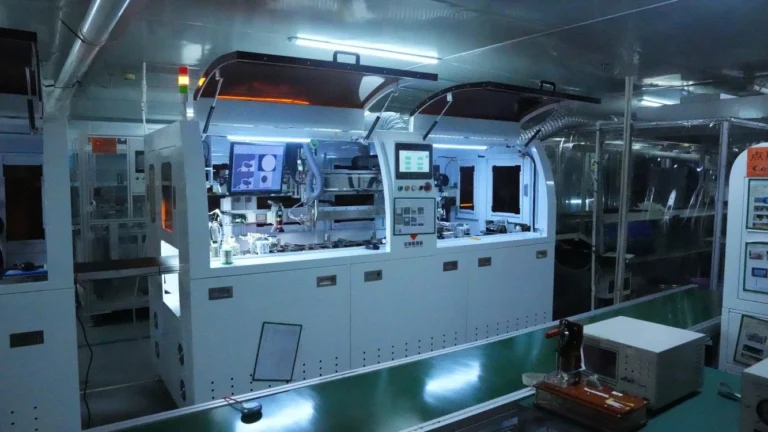
Optical bonding is central to Jictech’s approach to sunlight readability. Their production lines master both OCA (Optically Clear Adhesive) dry bonding and OCR (Optically Clear Resin) wet bonding, selecting the optimal route based on each customer’s specific requirements.
OCA Dry Bonding uses pre-cut solid optical adhesive film, laminated to the cover glass or touch panel and LCD panel through vacuum heat pressing. This process is fast, offers high yield rates, and is particularly well-suited for flat, small-to-medium-sized industrial display modules in volume production. Jictech carefully matches the refractive index of OCA materials (typically 1.48–1.52) to closely align with glass and polarizer properties, maximizing interface reflection elimination. Their production lines also feature vacuum de-bubbling equipment that removes microscopic air bubbles under negative pressure after lamination, ensuring the optical layer remains free of defects that could degrade display quality.
OCR Wet Bonding uses liquid optical resin, precisely dispensed across the display surface using automated equipment, then covered with protective glass and cured under UV light. OCR’s advantage is its fluidity—it perfectly fills curved, irregular, or stepped display module structures, making it ideal for automotive curved screens, curved industrial panels, and other complex designs. Once cured, OCR adhesive layers also deliver superior impact and vibration resistance, which is especially valuable for automotive and construction machinery applications where constant vibration is the norm.
Both bonding processes share the same fundamental goal: eliminate air gaps entirely. Industry testing shows that optically bonded display modules can reduce internal reflections by approximately 85%—a difference you can literally see with your naked eye in bright sunlight.
4.2 High-Brightness Backlight Customization and Thermal Management Engineering
Jictech takes a “systems engineering” approach to high-brightness backlights rather than simply stacking more LEDs.
Their backlight solutions typically start at 800 nits and scale up to 1,500+ nits, covering everything from industrial control to outdoor signage. For LED selection, Jictech uses high-efficiency, low-degradation industrial-grade LED chips paired with precision-engineered LGP micro-dot structures, ensuring high brightness output while maintaining uniformity across the entire panel (typically controlled within ±5%).
But high brightness inevitably means high heat. Jictech’s solution starts at the module design stage with thermal simulation: metal backplates for heat conduction, thermally conductive silicone pads, and optional heat-dissipation fins all work together to rapidly channel heat away from the LEDs. For extreme temperature environments, they can integrate temperature sensors into the module that communicate with the driver circuit for intelligent thermal control—automatically reducing backlight power when internal temperatures exceed thresholds, protecting components while maintaining minimum readable brightness.
4.3 Surface Coating and Treatment Processes: The AG, AR, AF Combination
The outermost screen surface is the first line of defense against direct sunlight, and Jictech offers multiple surface treatment options:
AG (Anti-Glare) Treatment: Through chemical etching or physical sandblasting, micro-textures are formed on the protective glass surface. When sunlight hits, specular reflections are converted into diffuse reflections, eliminating blinding glare spots. This treatment is particularly suitable for outdoor kiosks, industrial control panels, and any scenario requiring prolonged screen viewing.
AR (Anti-Reflective) Coating: Using multi-layer vacuum evaporation or sputtering processes, nanometer-scale optical thin films are deposited on the glass surface. These films use optical interference to cancel out reflected light, dropping surface reflectivity from 4% to under 1%. The improvement in contrast under bright light is dramatic—text and icon edges become noticeably sharper.
AF (Anti-Fingerprint) Coating: Based on nano-scale oleophobic and hydrophobic materials, this creates a low-surface-energy layer with a lotus-leaf effect. Outdoor devices are often operated with gloved hands or bare fingers, and the AF coating significantly reduces fingerprint and grease adhesion, keeping the screen clear over time. This layer also offers some abrasion resistance, extending screen life in industrial environments.
In actual projects, Jictech frequently combines these treatments—for example, AR coating on the inner surface to reduce reflections, AG treatment on the outer surface to soften glare, and an AF topcoat to maintain cleanliness. This “sandwich” style of optical treatment can push comprehensive screen readability in bright light to an entirely new level.
4.4 Wide-Temperature Material Selection and Reliability Validation
Bright light environments usually mean high-temperature challenges. Jictech maintains strict industrial-grade standards for material selection:
- Liquid Crystal Materials: Wide-temperature nematic liquid crystals with operating ranges covering -20°C to +70°C, with extended models reaching -30°C to +80°C, ensuring proper molecular response whether under blazing sun or freezing conditions.
- Polarizers: High-durability iodine-based or dye-based polarizers with UV stabilization layers to prevent fading and polarization efficiency degradation from long-term ultraviolet exposure.
- Optical Adhesives: OCA/OCR adhesives validated through 85°C/85% RH high-temperature high-humidity aging tests and -40°C to +85°C thermal cycling tests, ensuring they won’t yellow, delaminate, or fail during long-term outdoor service.
- Driver ICs: Industrial-grade or automotive-grade driver chips supporting wide-temperature operation with overtemperature protection functionality.
Before shipping, Jictech modules undergo rigorous reliability validation: vibration testing (simulating vehicle jolts and bumps), shock testing, salt spray testing (for coastal or chemical environments), and extended high-temperature aging tests. These validations ensure that screens remain stable in real-world bright-light conditions—not just in laboratory “ideal data” scenarios.
4.5 Customization Capability: From Standard Products to Project-Specific Solutions
What’s worth emphasizing is that Jictech doesn’t just sell standard products. Their real strength lies in deep customization based on each customer’s specific application scenario.
For example, a customer needed to deploy outdoor monitoring equipment in a desert region—direct sunlight during the day, freezing temperatures at night, solar panel power supply, and extreme power sensitivity. Jictech developed a custom solution combining Transflective LCD + low-power backlight + optical bonding + wide-temperature materials + automatic brightness sensing, allowing the device to run with near-zero backlight power during daylight hours while automatically engaging low-power backlight at night.
Another example: an automotive OEM needed a curved center console screen with high brightness, vibration resistance, and precise touch response. Jictech solved the curved bonding challenge using OCR wet bonding, paired with high-brightness IPS panel + AR coating + IATF 16949 automotive-grade quality management, meeting the stringent requirements of the automotive original equipment market.
This “one customer, one strategy” customization capability is precisely what anchors Jictech’s position in the industrial display sector. They don’t just provide a screen—they provide a validated sunlight-readable optical solution.
Part 5: Final Thoughts
Keeping an LCD screen readable under bright sunlight is fundamentally a battle against the laws of optical physics. Engineers don’t have magic—they simply deploy precision techniques like high-brightness backlights, optical bonding, anti-reflective coatings, transflective technology, intelligent sensing, and wide-temperature materials, layer by layer, to weaken the sun’s assault while strengthening the screen’s defenses.
Individually, none of these technologies are revolutionary. The real difficulty lies in integrating them organically, finding the optimal balance between brightness, power consumption, cost, reliability, and image quality. That’s why sunlight-readable LCDs remain a specialized niche in the display industry—it requires not just component assembly, but system-level optical engineering capability.
And that’s precisely where professional manufacturers like Jictech add their value: transforming laboratory technologies into production-line realities—stable, mass-producible, and rigorously validated industrial-grade products. From the precision control of OCA/OCR optical bonding, to the optimized combination of AG/AR/AF surface treatments, to wide-temperature material selection and thermal management engineering, every step directly impacts how the screen performs under the blazing sun.
As outdoor digitization, connected vehicles, and industrial IoT continue to expand, demand for sunlight-readable displays will only grow. And supporting these applications are the optical technologies and manufacturing processes hiding behind the screen—out of sight, but absolutely critical.
Frequently Asked Questions (FAQ)
Q1: Can regular LCD screens be used outdoors at all? Are there any low-cost temporary fixes?
If you only need occasional outdoor use, there are some “hacky” workarounds: applying an anti-glare film, using a sun hood/shade, or manually maxing out the brightness. But these are limited solutions—anti-glare film only addresses surface reflections, not screen brightness; sun hoods are impractical for mobile scenarios; and consumer screens at “maximum brightness” are often still inadequate under midday sun. For devices that need to work outdoors long-term, investing in dedicated high-brightness or transflective LCD modules is the more reliable path.
Q2: Which is better—Transflective LCD or High-Brightness LCD? How do I choose?
It depends on your use case. If your device primarily operates outdoors and power consumption/battery life is critical (handheld measurement tools, solar-powered equipment), Transflective LCD is the better choice because it leverages sunlight for illumination, drastically reducing backlight power. If your device frequently transitions between indoor and outdoor use and demands vivid color saturation (medical tablets, premium vehicle entertainment screens), then a high-brightness transmissive LCD + optical bonding + auto-brightness adjustment is more suitable. Neither is universally superior—it comes down to scenario fit.
Q3: Is optical bonding really that important? How is it different from regular bonding?
The importance of optical bonding for bright-light environments cannot be overstated. Regular bonding (using double-sided tape or foam gaskets) leaves an air gap, causing severe internal reflections and parallax issues. Optical bonding uses refractive-index-matched adhesive to completely fill the gap, eliminating internal reflections, boosting contrast and perceived brightness, while enhancing structural integrity and water resistance. For any outdoor or bright-light application, optical bonding is essentially mandatory, not optional.
Q4: Do high-brightness screens consume a lot of power? Do they run hot?
Yes. Brightness and power consumption are roughly proportional—a 2,000-nit screen’s backlight might consume 6–7 times the power of a 300-nit screen, with corresponding heat increases. That’s why high-brightness solutions typically require intelligent brightness adjustment (auto-dimming based on ambient light) and active thermal management. If power consumption is a core concern, consider prioritizing Transflective LCD solutions, or design in ambient light sensors so the screen only runs at full power when absolutely necessary.
Q5: Besides brightness, what other parameters matter for outdoor LCD screens?
Beyond brightness (nits), several key parameters deserve attention: contrast ratio (can you distinguish details in bright light?), operating temperature range (will it black out in heat or slow down in cold?), protection rating (IP rating for dust/water resistance), viewing angle (IPS panels generally outperform TN), touch technology (capacitive touch performance after optical bonding vs. resistive touch reliability in harsh environments), and long-term reliability (UV aging, backlight lifespan, etc.). Don’t just look at the brightness number—evaluate the complete optical and structural solution.