






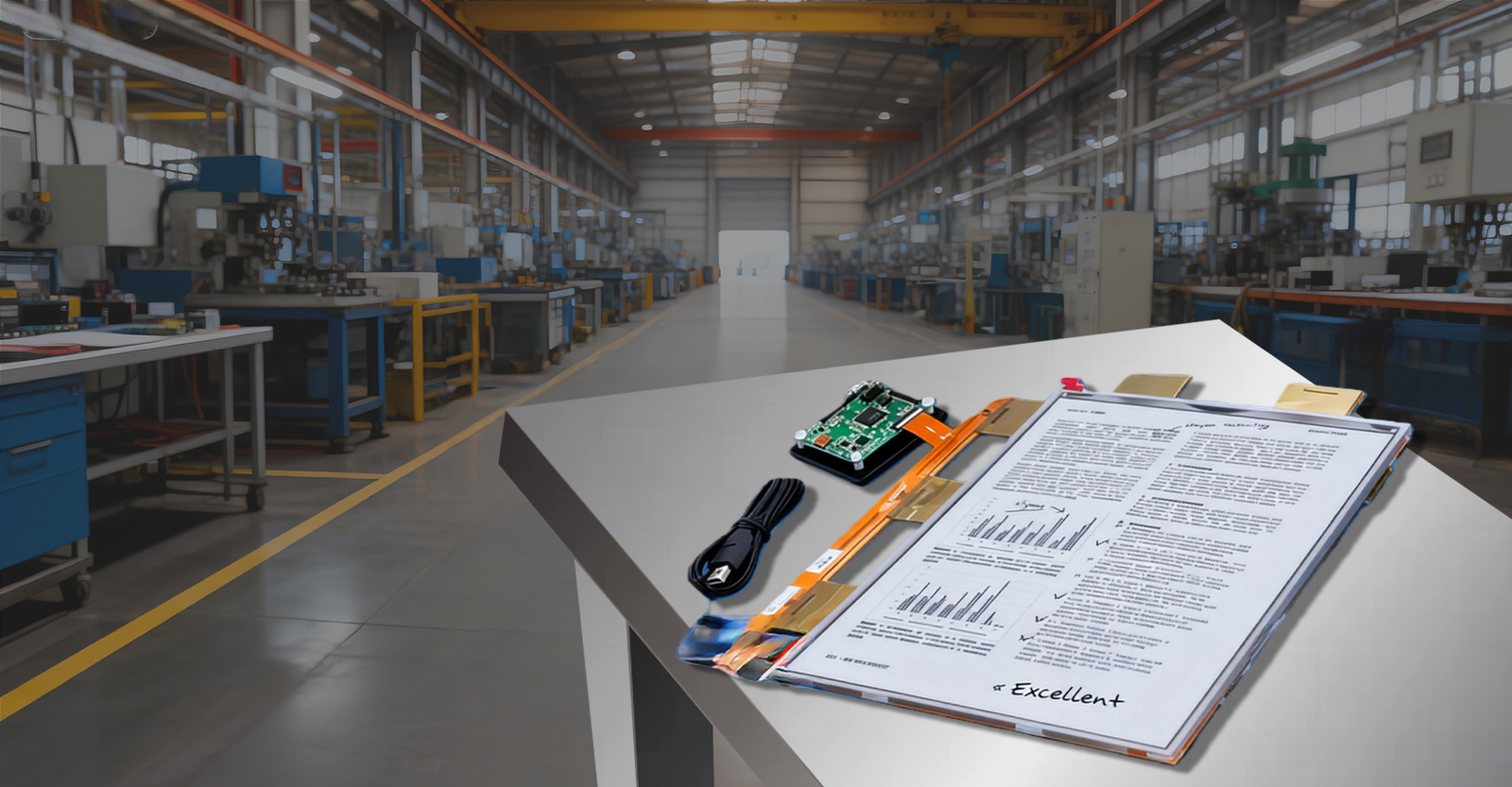

An Industry Insider’s Comprehensive Analysis of the 2026 E-Paper Display Landscape
Having spent over a decade tracking the evolution of display technologies—from the early days of segmented LCDs to today’s sophisticated electrophoretic panels—I’ve witnessed the e-paper industry transform from a niche curiosity into a $7.56 billion powerhouse. The year 2026 marks an inflection point where electronic paper display modules have moved beyond e-readers into retail automation, logistics tracking, and smart infrastructure.
What follows is my assessment of the ten manufacturers genuinely shaping this market. This isn’t a rehashed press release compilation; it’s based on patent filings, production capacity reports, and conversations with supply chain professionals who actually move these components from factory floors to end products.
The Market Context: Why 2026 Matters for E-Paper Display Technology
Before diving into individual manufacturers, let’s establish the landscape. The global e-paper display module market is projected to reach $14.96 billion by 2035, growing at a CAGR of 14.72% from 2026 onward . What’s driving this isn’t nostalgia for paper-like reading experiences—it’s the brutal economics of retail automation and IoT deployment.
Electronic shelf labels (ESLs) now represent the fastest-growing application segment, with the ESL market alone expected to hit $5.12 billion by 2035 . When a major European grocer can reduce pricing labor costs by 60% and improve accuracy by 35% using full-graphic e-paper ESLs, the business case becomes undeniable . This shift has fundamentally reordered the competitive hierarchy among e-paper display module suppliers.
1. E Ink Holdings Inc. — The Unassailable Technology Hegemon
Headquarters: Hsinchu, Taiwan | Core Technology: Electrophoretic Display (EPD) | 2026 Market Position: Dominant
Flagship Product Portfolio and Manufacturing Excellence
E Ink isn’t merely a manufacturer; it’s the foundational layer upon which most of the e-paper ecosystem rests. Their 2026 product stack centers on three pillars: the Kaleido 3 color e-paper platform (now achieving print-quality color saturation), the Carta 1300 monochrome series for premium e-readers, and the Spectra 6 six-color display for high-visibility retail signage.
What separates E Ink from competitors isn’t just technology—it’s manufacturing discipline. Their Hsinchu fab complex operates with the kind of yield rates that Chinese challengers are still struggling to match. The company’s 10x capacity expansion for Kaleido 3 panels, announced in early 2026, effectively neutralized early-stage competition from micro-LED alternatives in the digital signage space .
Patent Fortress and R&D Investment
E Ink holds the industry’s densest patent thicket, with over 6,000 granted patents covering electrophoretic microcapsule technology, waveform driving algorithms, and flexible substrate integration. Their intellectual property strategy isn’t defensive—it’s a moat that raises barriers to entry for any would-be challenger. The “E Ink Enabled” certification program creates a high-trust ecosystem where OEMs know they’re getting genuine, optimized components rather than knock-off alternatives .
The company’s R&D intensity remains exceptional. While exact figures are closely guarded, industry analysts estimate they reinvest 15-18% of revenue into next-generation display chemistry and frontplane manufacturing processes.
Customer Ecosystem and After-Sales Support
E Ink’s customer base reads like a who’s who of consumer electronics: Amazon (Kindle), Rakuten (Kobo), Sony (Digital Paper), and a growing roster of ESL system integrators including SES-imagotag and Pricer. Their technical support infrastructure spans Taiwan, Boston, and Dresden, providing application engineering support that smaller competitors simply cannot match.
Critical Assessment: E Ink’s dominance is double-edged. Their technology leadership is unquestioned, but the royalty costs associated with their patent estate create friction for smaller hardware integrators. For high-volume applications, this cost is absorbable; for niche implementations, it can be prohibitive. Their 2026 challenge isn’t maintaining technical leadership—it’s preventing market stagnation through pricing inflexibility.
2. Pervasive Displays Inc. — The Industrial IoT Efficiency Specialist
Headquarters: Tainan, Taiwan | Core Focus: Ultra-Low-Power Embedded Displays | 2026 Market Position: Strong Niche Leader
Specialized Product Lines for Harsh Environments
Pervasive Displays has carved out a defensible position by focusing on what they call “extreme efficiency”—e-paper modules designed for multi-year battery life in industrial and logistics applications. Their 2026 lineup emphasizes mid-size displays (2.9-inch to 12.2-inch) optimized for asset tracking, factory automation controls, and cold-chain monitoring.
Unlike E Ink’s broad-market approach, Pervasive Displays targets engineers building ruggedized devices. Their modules integrate seamlessly with ARM Cortex-M microcontrollers and offer extended temperature ranges (-20°C to 70°C) that consumer-grade displays cannot match.
Manufacturing Quality and Reliability Metrics
The company’s manufacturing partnerships in Taiwan maintain ISO 9001 and ISO 14001 certifications, with a particular emphasis on long-term supply continuity—a critical factor for industrial OEMs who cannot tolerate component obsolescence mid-product-lifecycle. Their displays are rated for 5+ year operational lifespans in continuous-use scenarios.
Customer Profile and Technical Support
Pervasive Displays serves a technically sophisticated customer base: industrial automation vendors, logistics companies deploying smart labels, and medical device manufacturers building portable diagnostic equipment. Their support model emphasizes deep technical documentation and reference designs rather than hand-holding, which suits their engineering-centric clientele.
Critical Assessment: Pervasive Displays represents the “specialist’s specialist” approach. They will never challenge E Ink for market share, but they don’t need to. Their 18% estimated market share in the ESL and industrial IoT segment provides sufficient scale for profitability without provoking direct confrontation with the market leader . The risk lies in potential acquisition—this would be a logical target for a larger display conglomerate seeking e-paper expertise.
3. Plastic Logic GmbH — The Flexible Display Pioneer
Headquarters: Dresden, Germany | Core Technology: Organic Thin-Film Transistor (OTFT) | 2026 Market Position: Technology Leader, Volume Challenger
Glass-Free Flexible E-Paper Module Innovation
Plastic Logic occupies a unique position as the only manufacturer delivering truly glass-free, bendable e-paper displays at commercial scale. Their organic TFT backplane technology enables displays that can wrap around curved surfaces, withstand repeated flexing, and survive impacts that would shatter conventional glass-based panels.
Their 2026 product focus targets three verticals: biometric smart cards (integrating fingerprint sensors with dynamic displays), wearable medical monitors requiring skin-conforming form factors, and ruggedized industrial badges. The company’s move toward biometric smart-card integration has secured a vital niche in the security and financial sectors .
Manufacturing Process and Quality Control
Plastic Logic’s Dresden facility operates with a fundamentally different manufacturing paradigm than silicon-based competitors. Their organic semiconductor deposition processes occur at lower temperatures, enabling plastic substrate compatibility. This comes with trade-offs: refresh rates remain slower than E Ink’s latest standards, limiting utility in interactive media applications .
Patent Portfolio and IP Strategy
With approximately 450 patents covering organic electronics and flexible display architectures, Plastic Logic maintains a defensible IP position in the OTFT space. Their patent strategy emphasizes manufacturing process protection rather than display physics, which complements rather than conflicts with E Ink’s core electrophoretic patents.
Critical Assessment: Plastic Logic’s technology is genuinely differentiated, but their manufacturing scale remains constrained. The company has undergone financial restructuring in recent years, and their long-term viability depends on successful pivoting toward high-value applications (medical, security) where flexibility commands premium pricing. For applications requiring unbreakable displays, they’re the only game in town—but that addressable market remains smaller than the rigid display mainstream.
4. BOE Technology Group Co., Ltd. — China’s Volume Champion
Headquarters: Beijing, China | 2026 Position: Aggressive Capacity Expander | Market Share: ~14-15% of EPD Shipments
Mass Production Capabilities and Scale Advantage
BOE has applied the same playbook that made them the world’s largest LCD manufacturer to e-paper: massive capital investment, aggressive capacity expansion, and relentless cost optimization. Their 2026 e-paper module production lines in Chengdu and Wuhan represent a CNY 46 billion investment targeting IT and signage applications .
The company’s strategy centers on capturing share in the high-growth ESL market and expanding into large-format digital signage where transportation and public information displays drive demand.
Quality Evolution and Technical Capabilities
BOE’s quality metrics have improved substantially—yield rates on their flexible AMOLED lines now approach 85%, up from sub-70% levels three years ago, suggesting their e-paper manufacturing discipline has similarly matured . However, industry contacts suggest their e-paper color consistency and waveform optimization still lag E Ink’s reference standards by 6-12 months.
Customer Base and Geographic Focus
BOE’s core customers remain domestic Chinese brands (Huawei, Xiaomi, Oppo, Vivo), providing volume stability but limiting pricing power in premium segments. Their qualification into Apple’s supply chain for other display technologies has not yet extended to e-paper modules, representing both a challenge and an opportunity.
Critical Assessment: BOE is the manufacturer to watch for price disruption. Their ability to operate at lower margins while scaling production creates downward pressure on industry pricing. For buyers prioritizing cost over absolute performance, BOE offers compelling value. For applications requiring guaranteed long-term supply stability and premium color performance, E Ink remains the safer choice.
5. LG Display Co., Ltd. — The Hybrid Architecture Strategist
Headquarters: Seoul, South Korea | 2026 EPD Focus: Large-Format Smart City Applications | Market Share: ~5.8% in EPD Segment
Strategic Positioning in Public Infrastructure
LG Display has refocused its e-paper efforts on hybrid architectures—blending e-paper with ultra-thin bezels and integrated touch for the Smart City sector. Their technical capability in 24/7 operation durability exceeds smaller vendors, making them attractive for transportation hubs and public information boards .
The company’s 2026 showcase includes tandem OLED 2.0 technology adapted for e-paper-adjacent applications, though e-paper remains secondary to their massive OLED and Micro-LED divisions .
Manufacturing Infrastructure and R&D Scale
LG operates production facilities across Korea, China, and Vietnam, with cumulative annual capacity of approximately 3.4 million glass sheets (8th-generation equivalent) . Their patent portfolio—31,163 domestic and 38,108 international filings—provides freedom to operate across display technologies .
Customer Relationships and Support Structure
Mercedes-Benz, BMW, General Motors, and Genesis constitute LG’s automotive display clientele, though these primarily utilize OLED rather than e-paper technologies. Their enterprise support infrastructure is enterprise-grade, with dedicated account teams for major deployments.
Critical Assessment: LG Display’s e-paper commitment remains opportunistic rather than strategic. They excel in large-format applications where their manufacturing scale provides advantage, but lack the focused R&D intensity of pure-play e-paper specialists. For municipal-scale digital signage projects, they’re a credible alternative to E Ink; for specialized e-paper applications, pure-plays offer deeper expertise.
6. Visionect — The Software-Integrated Solution Provider
Headquarters: Ljubljana, Slovenia | Core Competency: End-to-End E-Paper Signage Platforms | 2026 Position: Vertical Integration Leader
From Hardware to Full-Stack Digital Signage
Visionect represents a different breed of manufacturer—one that recognizes e-paper’s value lies not just in the display physics, but in the software stack that makes it useful. Their 2026 offerings include 32-inch large-format displays for corporate signage, room booking systems, and transportation information boards—all delivered with cloud-integrated management platforms.
Their hardware supply partnerships (notably with Plastic Logic for flexible applications) allow them to focus on differentiation through software and system integration rather than manufacturing commodity displays .
Deployment Expertise and Customer Success
Visionect’s customer base includes major European transportation authorities, corporate campuses, and hospitality chains. Their value proposition centers on reducing deployment complexity—providing CMS (Content Management System) integration, over-the-air updates, and fleet management tools that abstract away the underlying display hardware.
Support Model and Professional Services
Unlike component suppliers, Visionect operates on a solutions model with professional services engagements. Their support includes on-site installation assistance, custom CMS development, and ongoing fleet monitoring—capabilities that hardware-only manufacturers cannot easily replicate.
Critical Assessment: Visionect’s approach is prescient. As e-paper commoditizes, value migrates to software and integration. Their weakness is manufacturing dependency—they don’t control their own display production, creating potential supply risk. For buyers seeking turnkey solutions rather than component sourcing, Visionect offers compelling total-cost-of-ownership advantages.
7. CLEARink Displays Inc. — The Video-Capable E-Paper Contender
Headquarters: USA/Canada | Core Innovation: Electrophoretic-Electrowetting Hybrid | 2026 Status: Pre-Commercial Scaling
Next-Generation Reflective Display Technology
CLEARink occupies the speculative frontier of e-paper technology—developing displays that promise video refresh rates (30Hz+) while maintaining the low-power, sunlight-readable characteristics that define e-paper. Their technology combines electrophoretic and electrowetting approaches to achieve color saturation and motion capabilities beyond current EPD limitations .
As of 2026, CLEARink remains in pre-commercial scaling, with pilot production lines targeting 2027-2028 mass market availability. Their technology holds potential to disrupt the traditional e-paper/LCD dichotomy—if manufacturing challenges can be resolved.
Patent Position and Technical Differentiation
CLEARink’s patent portfolio focuses on the hybrid cell architecture and driving waveforms necessary for video-capable reflective displays. Their IP strategy emphasizes blocking positions around color reflective technology, creating potential licensing leverage if their technology achieves commercial traction.
Critical Assessment: CLEARink represents high-risk, high-reward speculation. If they successfully commercialize video-capable e-paper, they could capture significant share in signage and educational tablet markets. If manufacturing yields remain elusive, they risk becoming an acquisition target for IP value rather than operational continuity. For buyers with 2026 deployment timelines, they’re not yet a viable option; for strategic planning horizons beyond 2028, they’re worth monitoring.
8. OED Technologies Co., Ltd. — The Chinese Patent Challenger
Headquarters: Guangzhou, China | 2026 Position: Aggressive IP Contender | Market Presence: Regional Strength
Alternative Electrophoretic Display Development
Guangzhou OED Technologies has emerged as a significant Chinese challenger to E Ink’s patent dominance. Their 2026 legal status includes active patent opposition proceedings at the European Patent Office, where they’re challenging E Ink Corporation’s core electrophoretic display patents . This aggressive IP posture signals their intent to operate outside E Ink’s licensing ecosystem.
Manufacturing Scale and Cost Position
OED operates substantial manufacturing capacity in Guangdong Province, targeting the domestic Chinese market and price-sensitive export segments. Their production lines emphasize cost optimization over premium performance, making them competitive in commodity ESL and price-tag applications.
Customer Base and Geographic Concentration
OED’s customer base remains concentrated in Chinese domestic retail chains and Southeast Asian markets where E Ink’s royalty costs create pricing pressure. Their support infrastructure is Asia-centric, with limited presence in European or North American markets.
Critical Assessment: OED represents the “patent workaround” strategy—attempting to build market share in jurisdictions where E Ink’s IP enforcement is less absolute. Their legal battles with E Ink will likely define their 2026-2027 trajectory. For buyers in non-litigious markets seeking cost-optimized alternatives, OED offers value; for global deployments requiring IP indemnification, they present unacceptable risk.
9. Tianma Microelectronics Co., Ltd. — The Display Conglomerate Diversifier
Headquarters: Shenzhen, China | 2026 EPD Focus: Dual-Display and Hybrid Applications | Market Position: Emerging
Micro-LED and E-Paper Integration Strategy
Tianma’s 2026 technology roadmap reveals a sophisticated dual-display strategy. Their DIC Forum 2025 presentation showcased a “5-inch Micro-LED + E-paper dual display” prototype, indicating an approach that combines e-paper’s low-power persistence with Micro-LED’s dynamic range for specific automotive and industrial applications .
Manufacturing Infrastructure and Scale
Tianma operates extensive manufacturing facilities across China, with particular strength in LTPS (Low-Temperature Polysilicon) backplane technology that enables high-resolution, low-power displays. Their industrialization phase (2024-2026) aims to establish large-scale mass production systems for Micro-LED, with e-paper integration as a secondary capability .
Customer Relationships and Application Focus
Tianma’s customer base spans automotive OEMs, industrial equipment manufacturers, and consumer electronics brands. Their e-paper offerings target specialized applications—automotive cluster displays requiring always-on information persistence, and industrial HMI (Human-Machine Interface) panels where power interruption resilience matters.
Critical Assessment: Tianma’s e-paper presence remains opportunistic rather than strategic. Their dual-display approach offers genuine innovation potential, particularly for automotive applications, but they lack the focused R&D intensity of e-paper specialists. For buyers seeking hybrid display solutions, Tianma offers unique capabilities; for pure e-paper requirements, specialists provide better support depth.
10. DKE Co., Ltd. (Dalian East Kemai Electronics) — The ESL Manufacturing Specialist
Headquarters: Dalian, China | 2026 Core Market: Electronic Shelf Label Modules | Market Position: Volume Supplier
Focused ESL Display Module Production
DKE (also referenced as Dalian East Kemai Electronics in industry reports) has established itself as a significant volume supplier in the ESL display module segment. Their manufacturing focuses on the 1.3-inch to 3.5-inch display sizes that dominate retail shelf labeling applications .
Production Scale and Cost Competitiveness
As one of the top ten manufacturers collectively holding approximately 70% of global e-paper display module market share, DKE operates with the scale economies necessary for high-volume ESL production . Their cost structure enables competitive pricing for large retail chain rollouts, though their technology remains licensed from E Ink’s patent estate.
Customer Profile and Regional Strength
DKE’s customer base includes ESL system integrators and retail automation vendors, particularly in Asian markets. Their support infrastructure is manufacturing-centric, with less emphasis on application engineering compared to E Ink or Pervasive Displays.
Critical Assessment: DKE represents the “efficient manufacturer” tier—companies that execute well on licensed technology without attempting fundamental innovation. Their 2026 challenge is margin compression as BOE and other larger display makers enter the ESL segment with aggressive pricing. For buyers prioritizing supply security and cost optimization in high-volume ESL deployments, DKE offers credible alternatives to E Ink direct sourcing.
Comparative Analysis: Selecting the Right E-Paper Display Module Manufacturer
Choosing among these ten manufacturers requires matching specific application requirements to supplier capabilities:
| Manufacturer | Best For | Key Strength | Primary Limitation |
|---|---|---|---|
| E Ink Holdings | Premium e-readers, color signage, high-volume ESL | Technology leadership, IP dominance | High royalty costs, pricing inflexibility |
| Pervasive Displays | Industrial IoT, asset tracking, rugged environments | Ultra-low power optimization, long-term supply | Limited color capabilities, smaller scale |
| Plastic Logic | Wearables, smart cards, flexible medical devices | Unbreakable flexible form factors | Slower refresh rates, higher unit costs |
| BOE | Cost-sensitive large deployments, Chinese market | Mass production scale, aggressive pricing | Color consistency, premium application support |
| LG Display | Smart city signage, transportation hubs | Large-format manufacturing, enterprise support | Opportunistic e-paper focus, secondary priority |
| Visionect | Turnkey signage solutions, corporate deployments | Software integration, deployment support | Hardware supply dependency |
| CLEARink | Future video-capable applications (2027+) | Video refresh potential, next-gen color | Pre-commercial status, manufacturing risk |
| OED Technologies | Price-sensitive Asian markets | Cost optimization, regional presence | IP litigation risk, limited global support |
| Tianma | Hybrid display applications, automotive | Dual-display innovation, LTPS backplane | Opportunistic e-paper focus |
| DKE | High-volume ESL commodity supply | Manufacturing efficiency, cost position | Limited differentiation, margin pressure |
Regulatory, Environmental, and Sustainability Considerations
The e-paper industry faces increasing regulatory scrutiny regarding electronic waste management and material sustainability. Environmental regulations across the EU, California, and China are influencing manufacturers to adopt eco-friendly production processes and design for recyclability .
E Ink has led in this area with their “E Ink Enabled” sustainability certification, while European manufacturers (Plastic Logic, Visionect) benefit from proximity to stringent EU environmental standards. Chinese manufacturers are rapidly adapting to meet these requirements as they expand into European markets.
For buyers with corporate sustainability mandates, manufacturer environmental certifications and supply chain transparency are becoming selection criteria alongside technical specifications.
Frequently Asked Questions (FAQ)
What makes E Ink Holdings so dominant in the e-paper display module market?
E Ink’s dominance stems from three factors: (1) patent control over core electrophoretic microcapsule technology, creating high barriers to entry; (2) manufacturing scale and yield rates that competitors struggle to match; and (3) the “E Ink Enabled” certification ecosystem that ensures quality consistency across OEM implementations. Their 65%+ market share reflects genuine technical leadership rather than mere first-mover advantage .
How do I choose between rigid and flexible e-paper display modules for my application?
Rigid e-paper modules (E Ink, BOE, Pervasive Displays) offer lower cost, higher resolution, and faster refresh rates—ideal for e-readers, ESLs, and signage. Flexible modules (Plastic Logic) command 3-5x price premiums but enable form factors impossible with glass substrates—wearables, smart cards, and curved surfaces. The decision hinges on whether your application benefits from flexibility enough to justify the cost differential.
What is the typical lifespan of an e-paper display module in commercial deployment?
Quality e-paper modules from tier-1 manufacturers (E Ink, Pervasive Displays) are rated for 5-10 years of operational life, with some industrial-grade variants specified for 10+ years. The bistable nature of electrophoretic displays (power only required for updates, not for image maintenance) contributes to exceptional longevity compared to emissive technologies like OLED.
Are there viable alternatives to E Ink for color e-paper display modules?
As of 2026, E Ink’s Kaleido 3 platform remains the only commercially proven color e-paper technology at scale. CLEARink promises video-capable color but remains pre-commercial. BOE offers color alternatives but with performance gaps in color saturation and refresh consistency. For 2026 deployments requiring proven color e-paper, E Ink remains the practical choice despite royalty costs.
How does the electronic shelf label (ESL) market growth affect e-paper display module demand?
The ESL market is the primary growth driver for e-paper display modules in 2026, with demand growing at 120.8% quarter-over-quarter . This has created supply constraints for popular sizes (1.5-inch to 3-inch), extended lead times, and attracted new manufacturing investment from BOE and other display conglomerates. Buyers planning ESL deployments should secure supply agreements 6-12 months in advance given current demand intensity .
Conclusion: The 2026 E-Paper Display Module Landscape
The e-paper display module industry in 2026 is characterized by a clear hierarchy: E Ink maintains technology leadership and premium positioning, Chinese manufacturers (BOE, OED, DKE) drive cost optimization and volume expansion, and specialists (Pervasive Displays, Plastic Logic, Visionect) carve defensible niches through application expertise.
For procurement professionals and product designers, the key insight is that “e-paper” is not a commodity—display module selection profoundly impacts product performance, power consumption, and total cost of ownership. The manufacturers profiled here represent genuine differentiation in a market often mistakenly viewed as monolithic.
The coming 24 months will likely see further consolidation, with smaller Chinese manufacturers facing margin pressure and potential acquisition by larger display conglomerates seeking e-paper capabilities. For buyers, this suggests prioritizing supply agreements with tier-1 manufacturers while monitoring CLEARink’s commercialization progress for potential 2027-2028 disruption.