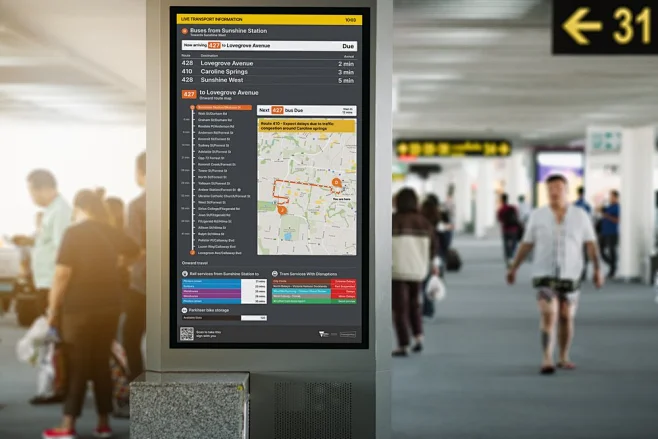









The recent expansion of electrophoretic displays beyond dedicated e-readers into retail signage, transportation information systems, and large-format advertising is not a marketing phenomenon. It follows from a straightforward physical property: bistability. In an electrophoretic display (EPD), the optical state of each pixel is maintained by the position of charged pigment particles within a dielectric fluid. Once the particles are set, no electrical bias is required to keep them in place. The display draws power only during the transition from one state to another.
This characteristic alone explains most of the commercial interest. But the technology comes with a specific set of engineering constraints—refresh rate, color gamut, temperature sensitivity, and manufacturing yield—that determine where it can be deployed and where it cannot.
Power Consumption and the Static State
In practical terms, the power consumption of an e-paper display is dominated by two factors: the energy required to switch the particles and the leakage current of the thin-film transistor (TFT) backplane during the hold state. For a 32-inch display, the static power draw measures approximately 0.4 W. Most of this is not consumed by the electrophoretic film itself but by the supporting electronics—the timing controller, level shifters, and the TFT gate drivers that maintain the voltage bias on the storage capacitors. By comparison, a 32-inch LCD panel of comparable resolution draws roughly 34 W in steady operation, because it must refresh every row at 60 Hz regardless of content changes.
This difference is not incremental; it is fundamental to the operating principle. In an LCD, the liquid crystal molecules relax back to their ground state unless actively driven. In an EPD, the charged particles remain at the electrode surface indefinitely. The only leakage path is through the thin-film transistors, which in modern amorphous-silicon or metal-oxide backplanes contributes on the order of nanoamperes per pixel.
For applications that require infrequent updates—electronic shelf labels, wayfinding signs, transit schedules—the reduction in energy consumption is substantial. A single 75-inch outdoor e-paper sign updated every few minutes consumes less energy over a 24-hour cycle than a 32-inch LCD consumes in one hour.
Reflective Optics and Readability
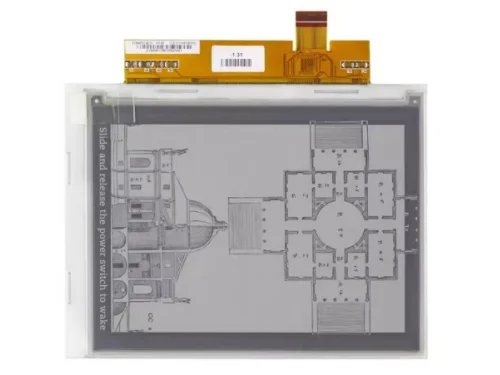
The optical behavior of an EPD is fundamentally different from emissive or transmissive displays. The electrophoretic film reflects ambient light, scattering it back to the viewer. The reflectance of a typical black-white EPD is around 45–50% for the white state and 4–6% for the black state, yielding a contrast ratio of approximately 10:1 under standard illumination. This is significantly lower than the contrast of a high-quality LCD (1000:1 or better) but the perceived legibility in bright ambient light is actually superior because there is no front-surface reflection from a backlight unit and no need to overpower sunlight.
The display operates as a Lambertian reflector: the reflected intensity is independent of viewing angle. This is not true for LCDs, where off-axis viewing introduces contrast degradation and color shift. In direct sunlight—illuminance exceeding 100,000 lux—an emissive display must increase its peak luminance to several thousand nits to remain readable, which drives power consumption into the tens of watts. An EPD, by contrast, becomes more readable as the ambient light increases, because the reflected intensity scales with the illumination.
Color Reproduction and Its Limits
The transition to color has been the primary technical driver of recent market growth. Current color EPDs use one of two architectures. The first, represented by E Ink’s Kaleido platform, applies a patterned color filter array (CFA) over a monochrome electrophoretic layer. The subpixels are arranged in a traditional RGB stripe or RGBW pattern, with the black-white particles generating grayscale underneath. The optical efficiency of this approach is limited: each color filter transmits only one-third of the reflected light, so the white-state reflectance drops to approximately 25–30%, and the color gamut covers roughly 15–20% of the NTSC standard.
The second approach, used in E Ink’s Gallery 3, employs three types of charged particles—cyan, magenta, and yellow—in a single microcapsule or microcell. By applying different voltage waveforms, the particles can be separated vertically to produce full color without a filter array. This improves optical efficiency and eliminates the moiré artifacts inherent to CFA designs, but it introduces significant waveform complexity. The voltage sequences required to separate three populations of particles with distinct electrophoretic mobilities must be carefully tuned over temperature and over the lifetime of the display.
Neither approach approaches the color saturation of OLED or even mid-range LCD panels. The color gamut of Spectra 6, E Ink’s latest large-format platform, exceeds that of newspaper print but falls short of coated magazine paper. For retail signage and advertising, the trade-off is acceptable because the low power consumption and sunlight readability offset the reduced color vibrancy.
Temporal Response and the Video Barrier
The refresh rate of an EPD is constrained by the physical movement of particles. In a typical electrophoretic ink, the particle velocity is determined by the product of zeta potential and electric field strength divided by the fluid viscosity. The time required for particles to traverse the cell gap—approximately 20 to 50 micrometers—is on the order of 200 to 500 milliseconds for a full grayscale update. This yields an effective refresh rate of 2 to 5 frames per second, which is insufficient for video.
The T2000 controller architecture, introduced in 2025, improves this substantially by overlapping the image data transmission with the waveform update process. Under this architecture, a 75-inch Kaleido display achieves 11 frames per second on a half-area update (5120 × 1440 pixels) and up to 13 fps for partial animations. The architecture does not reduce the physical switching time; it pipelines the data flow so that the display is not waiting for the host system to deliver the next frame. The actual switching time of the particles remains the limiting factor, and the 11–13 fps figure applies only to partial updates where the particle displacement is small.
For full-screen black-to-white transitions, the update time remains approximately 500 ms. This is not a deficiency; it is a consequence of the fluid mechanics governing particle motion. Faster updates require higher electric fields, which increase power consumption and accelerate degradation of the dielectric fluid and electrode materials.
The Temperature Dependency
Electrophoretic displays exhibit significant temperature dependence because the fluid viscosity is a strong function of temperature. At 25°C, the standard operating point, a typical update waveform completes in 300 ms. At 0°C, the viscosity increases by a factor of two to three, extending the update time to 600–900 ms. At −10°C, operation requires elevated drive voltages to compensate for the increased viscous drag, and the yield of successful grayscale transitions drops.
At the high end, at 50°C, the fluid viscosity decreases, and the particles switch too quickly. This causes overshoot in the grayscale levels, requiring shortened waveform pulses and additional calibration. Most commercial EPDs are specified for operation between 0°C and 50°C. The Marquee platform extends this range by using a modified particle chemistry and a four-particle system that is less sensitive to viscosity variations, but the temperature compensation circuitry remains essential.
Mechanical Flexibility and Substrate Engineering
The transition from glass to flexible substrates—polyimide (PI) or polyethylene terephthalate (PET)—has opened new form factors. The electrophoretic film itself is inherently flexible because it is a polymer matrix containing microcapsules or microcells. The challenge has been the TFT backplane, which in conventional displays is fabricated on rigid glass. Flexible EPDs use plastic substrates with thin-film barrier coatings to prevent moisture ingress—the electrophoretic fluid is hydrophobic, but the dielectric fluid can absorb water vapor, which alters the zeta potential of the particles.
Samsung’s 13-inch color display with a bio-resin housing demonstrates the integration of mechanical design with environmental sustainability, but the core engineering challenge remains the yield and uniformity of the TFT deposition on plastic. Metal-oxide TFTs, such as IGZO, have higher carrier mobility than amorphous silicon, which allows smaller transistor dimensions and reduces leakage current, but they require low-temperature deposition processes compatible with plastic substrates.
The 3D surface wrapping demonstrated in the BMW concept car uses segmented display modules bonded to curved body panels. The adhesion between the flexible EPD and the underlying surface must accommodate coefficient of thermal expansion mismatches, and the electrical interconnects must sustain repeated bending without delamination. These are solvable mechanical engineering problems, but they add cost and complexity that limit production applications.
Sustainability Metrics
From an environmental engineering perspective, the primary advantage of EPDs is the reduction in operational energy. The manufacturing energy for an EPD is comparable to an LCD of the same size—the TFT lithography, coating, and lamination processes are similar. The difference lies in the use phase. An EPD digital sign operating for five years with hourly updates consumes approximately 2–5 kWh total. An LCD sign of the same size consumes approximately 1,500–2,000 kWh over the same period.
The reduction in battery capacity requirements for IoT devices is equally significant. A 32-inch e-paper sign can operate on a 72 Wh battery pack, as in LG’s 2026 commercial product, whereas an LCD would require mains power or a much larger battery bank. For outdoor transit information displays, the combination of e-paper and photovoltaic panels achieves net-zero energy operation in most climates.
Known Failure Modes and Longevity
The longevity of an EPD is limited by two factors: particle agglomeration and fluid degradation. Over time, the charged particles tend to aggregate, reducing the optical contrast. This is mitigated by polymer coatings on the particle surfaces, but the coatings degrade under prolonged exposure to the electric field and temperature cycling. The dielectric fluid—typically a hydrocarbon oil—undergoes oxidation and loses its insulating properties, which increases the leakage current and shifts the threshold voltage.
Manufacturers specify an operational lifetime of 5 to 10 years for indoor signage and 3 to 5 years for outdoor applications. The outdoor degradation is accelerated by UV exposure, which breaks down the polymer matrix and the particle surface treatments. UV-blocking front films are applied, but they reduce the transmittance and affect the optical efficiency.
Conclusion: The Niche Is the Point
E-paper is not replacing LCD or OLED. It is a complementary technology that occupies the region of the design space where power consumption, sunlight readability, and static content take priority over color accuracy, refresh rate, and video playback. The expansion of the technology into signage, retail, and transportation is not a sign that the limitations have been overcome; it is a sign that the cost and performance have reached a point where the trade-offs are acceptable for a wider set of applications.
The technical trajectory—larger substrates, improved color gamut, faster partial updates—extends the reach of the technology, but the underlying physics remain unchanged. The charged particles still move through a fluid, and the fluid still has viscosity. The trends in the market reflect not a revolution in the display physics but a growing recognition that, for a significant fraction of display applications, static information displayed with minimal power is preferable to high-refresh, high-power alternatives.
Consulting Engineer