








An automotive grade display is a specialized visual interface engineered to withstand the extreme environmental, mechanical, and operational demands of the vehicular environment while maintaining strict safety and reliability standards over a prolonged lifecycle. Unlike consumer electronics screens found in smartphones or tablets, these displays are not merely “ruggedized”; they are fundamentally designed from the silicon up to operate reliably between -40°C and +85°C (or higher), resist intense vibration and shock, ensure readability under direct sunlight and total darkness, and adhere to rigorous functional safety protocols like ISO 26262 to prevent catastrophic failures that could distract a driver or compromise vehicle control.
The Reality of the Road: Why Consumer Screens Fail in Cars
Having spent over a decade working with Tier 1 suppliers and OEMs on cockpit integration, I’ve seen too many projects stumble because stakeholders underestimated the gap between “industrial” and “automotive.” A screen that works perfectly in a factory control panel will often fail within months inside a car parked in the Arizona sun or a garage in northern Scandinavia.
The core differentiator isn’t just durability; it’s predictability. In the consumer world, if your phone screen flickers or dims unexpectedly, it’s an annoyance. In a vehicle, especially when displaying speed, warning lights, or rear-view camera feeds, such behavior is a safety hazard. Automotive grade displays are built on the philosophy of “zero defects” during their operational life, which typically spans 10 to 15 years—far exceeding the 2-3 year lifecycle of a smartphone.
Critical Characteristics: Beyond Brightness and Resolution
When we define what makes a display “automotive grade,” we are looking at a specific set of non-negotiable characteristics:
1. Extreme Temperature Resilience
This is the most common failure point. Standard LCD liquid crystals can freeze (becoming unresponsive) or turn black (nematic-isotropic transition) at high temperatures. Automotive panels use specialized liquid crystal formulations and heater elements (for cold starts) to ensure operation from -40°C to +85°C ambient, with storage temperatures reaching up to +95°C. The backlight unit (BLU) must also survive these extremes without delaminating or yellowing.
2. Optical Performance in Variable Lighting
A driver must read the instrument cluster at noon in direct sunlight and at midnight in a pitch-black tunnel without adjustment lag. This requires:
- High Brightness: Typically 1,000 to 2,500 nits for center stack displays, compared to 500-800 nits for consumer devices.
- Anti-Reflective (AR) & Anti-Glare (AG) Coatings: Essential to reduce specular reflections that cause eye strain.
- Local Dimming: Increasingly common in Mini-LED backlights to improve contrast ratios and ensure deep blacks for night driving modes.
3. Mechanical Robustness
Vehicles are vibrating machines. Displays must pass stringent shock and vibration tests (often following ISO 16750-3) simulating potholes, engine resonance, and crash impacts. The bonding technology (optical bonding) between the touch sensor, cover glass, and LCD panel is critical here to prevent Newton rings or separation under stress.
4. Long-Term Availability and Consistency
Automotive programs last a long time. You cannot source a display that will be discontinued in 18 months. Automotive grade suppliers guarantee long-term supply (often 7-10 years) and strict consistency in color gamut, brightness, and dimensions across production batches. You don’t want the left-hand drive model to have a slightly different white point than the right-hand drive version.
Application Scenarios: Where Are They Used?
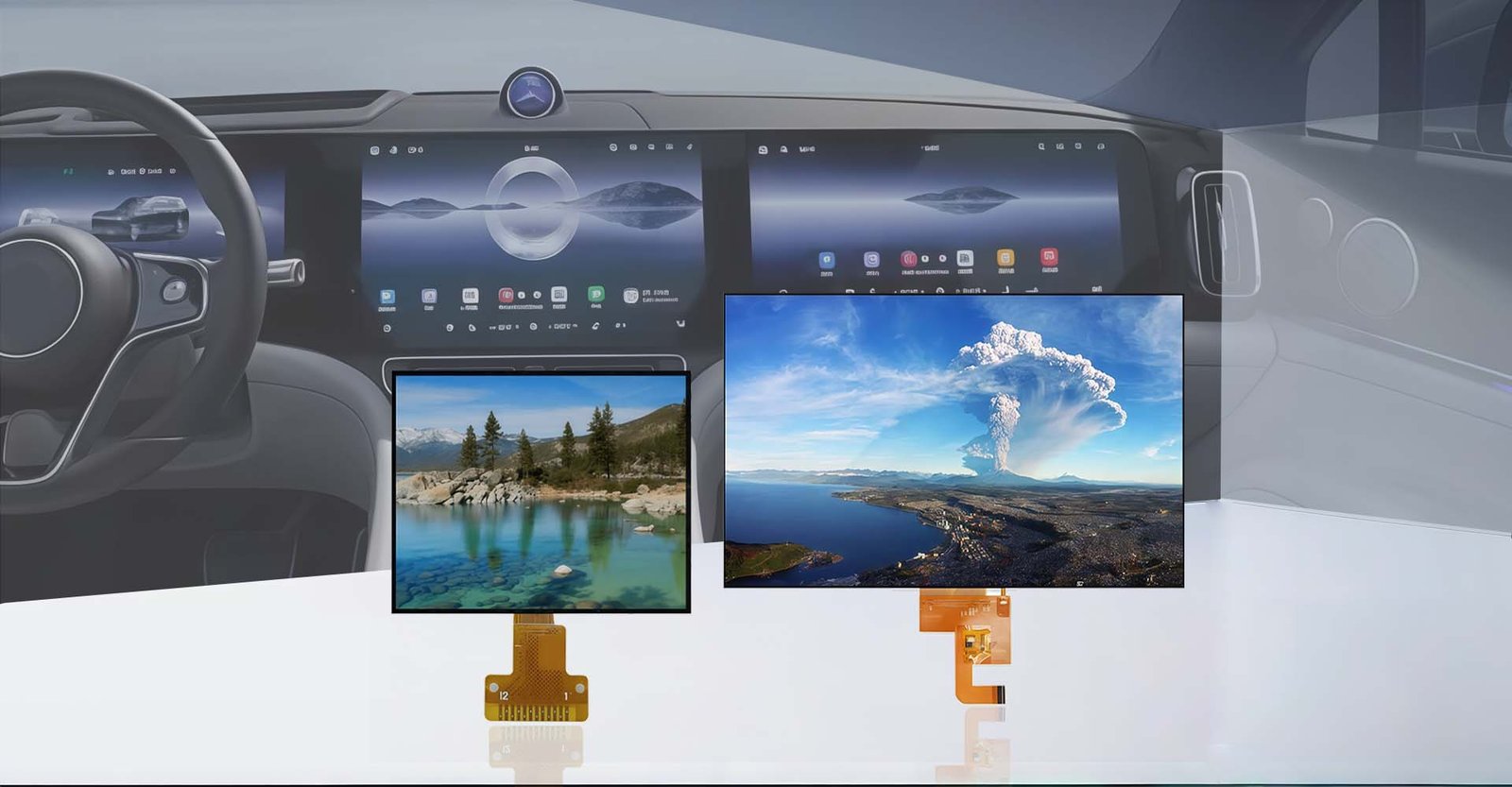
The modern vehicle is essentially a data center on wheels, and automotive grade displays are the primary human-machine interface (HMI):
- Digital Instrument Clusters (IC): Replacing analog gauges. Requires highest reliability and fastest response times.
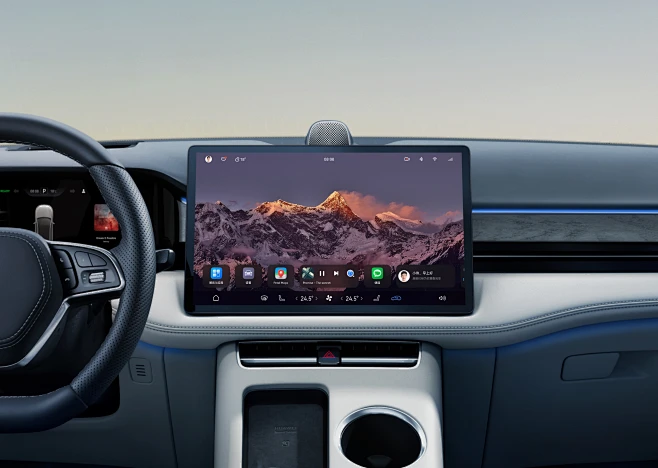
- Center Information Displays (CID): Infotainment, navigation, and vehicle settings. Often large, high-resolution touchscreens.
- Electronic Side Mirrors (CMS) & Rear Camera Monitors: Safety-critical applications where latency and image clarity are paramount.
- Passenger Entertainment Displays: Rear-seat screens, which still require automotive durability but may have slightly relaxed functional safety requirements compared to the driver’s view.
- Head-Up Displays (HUD): Projecting critical data onto the windshield, requiring specialized transparent combiners and high-brightness projection units.
Selection Strategy: How to Choose the Right Panel
Selecting an automotive display is not a spec-sheet exercise; it’s a risk management process. Based on my experience guiding procurement teams, here is the practical approach:
- Define the Safety Level Early: Is this an ASIL-B (Automotive Safety Integrity Level) application? If the display fails, does it endanger life? This dictates the controller architecture and redundancy needed.
- Validate the Supply Chain: Do not buy from brokers. Engage directly with manufacturers who have a dedicated automotive division (e.g., Jictech, BOE, Tianma, Innolux, LG Display, Japan Display). Verify their production lines are IATF 16949 certified.
- Prototype Environmental Testing: Never skip the “oven and freezer” test. Run your specific optical bonding and assembly configuration through thermal cycling before mass production. The panel might be rated for 85°C, but your adhesive might fail at 75°C.
- Touch Technology Consideration: In cars, capacitive touch must work with gloves and in wet conditions. Resistive overlays or hybrid solutions are sometimes still preferred for critical controls due to their tactile feedback and reliability in adverse weather.
The Gatekeepers: Mandatory Certifications
You cannot ship an automotive display without passing specific industry certifications. These are not optional badges; they are entry tickets.
- IATF 16949: The gold standard for quality management systems in the automotive supply chain. It supersedes ISO 9001 with stricter requirements for defect prevention and variation reduction.
- ISO 26262: The functional safety standard. Displays intended for safety-critical roles (like clusters) must comply with specific ASIL levels (A through D). This covers everything from the hardware design to the software driving the pixels.
- AEC-Q100 / Q200: While primarily for ICs and passive components, the principles extend to the display module’s electronic drivers. The display assembly must demonstrate reliability under stress testing defined by these standards.
- ISO 16750: Specifically addresses environmental conditions and testing for electrical/electronic equipment in road vehicles (climatic, mechanical, chemical loads).
- UN ECE R46 / R118: Specific regulations for mirrors and burning behavior of materials, relevant to the physical construction of the display unit.
Final Thoughts
Transitioning from consumer to automotive grade is a shift in mindset from “fast and feature-rich” to “safe and reliable forever.” As vehicles become more autonomous, the display becomes the primary conversation between the car and the human. Choosing the right automotive grade display isn’t just about picking a screen; it’s about ensuring trust in every mile driven.
Frequently Asked Questions (FAQ)
A: Generally, no. While industrial displays offer better durability than consumer ones, they rarely meet the specific temperature ranges (-40°C to +85°C), vibration profiles, and 10+ year lifecycle availability required by automotive OEMs. Using them risks field failures and liability issues, especially for safety-critical applications.
A: Automotive displays have significantly longer lead times. Due to the rigorous validation processes (which can take 12-24 months) and guaranteed long-term production runs, you often need to secure supply agreements 2-3 years before the vehicle launch. Consumer screens operate on much faster, volatile cycles.
A: No. “Automotive grade” refers to environmental and mechanical robustness. Functional safety (ISO 26262) is a separate certification regarding the system’s ability to prevent hazardous failures. A display can be rugged enough for a car but lack the redundant circuitry or safety mechanisms required for ASIL-rated applications like instrument clusters.
A: The cost reflects the specialized materials (wide-temp liquid crystals), rigorous testing protocols, lower production volumes per SKU, guaranteed long-term supply, and the overhead of maintaining IATF 16949 quality systems. You are paying for the assurance that the screen won’t fail in extreme conditions over a decade.
A: While phones use auto-brightness, automotive displays are engineered with inherently higher peak brightness (often 1000+ nits vs 600 nits), superior anti-reflective coatings, and optical bonding to eliminate internal air gaps that cause reflections. They are tuned specifically to maintain contrast ratios in direct sunlight without draining the vehicle’s battery excessively or overheating.